Introduction
Modern pipeline optimization has started to feel a bit like watchmaking: every gear matters, tolerances are tight, and a small imbalance can throw the whole mechanism off. The scale makes it harder each year. Global demand for data movement is growing at a pace that mirrors the market itself, which is projected to expand from $8.22B in 2023 to $33.87B by 2030.
Today’s systems rely on data pipeline optimization to keep operations stable as volumes surge and real-time processing becomes the norm. Costs rise quickly when pipelines stall; reliability suffers when they drift out of alignment. Across most mature engineering setups, the combination of Kubernetes, DevOps practices, and SRE discipline is what keeps data pipelines predictable rather than temperamental.
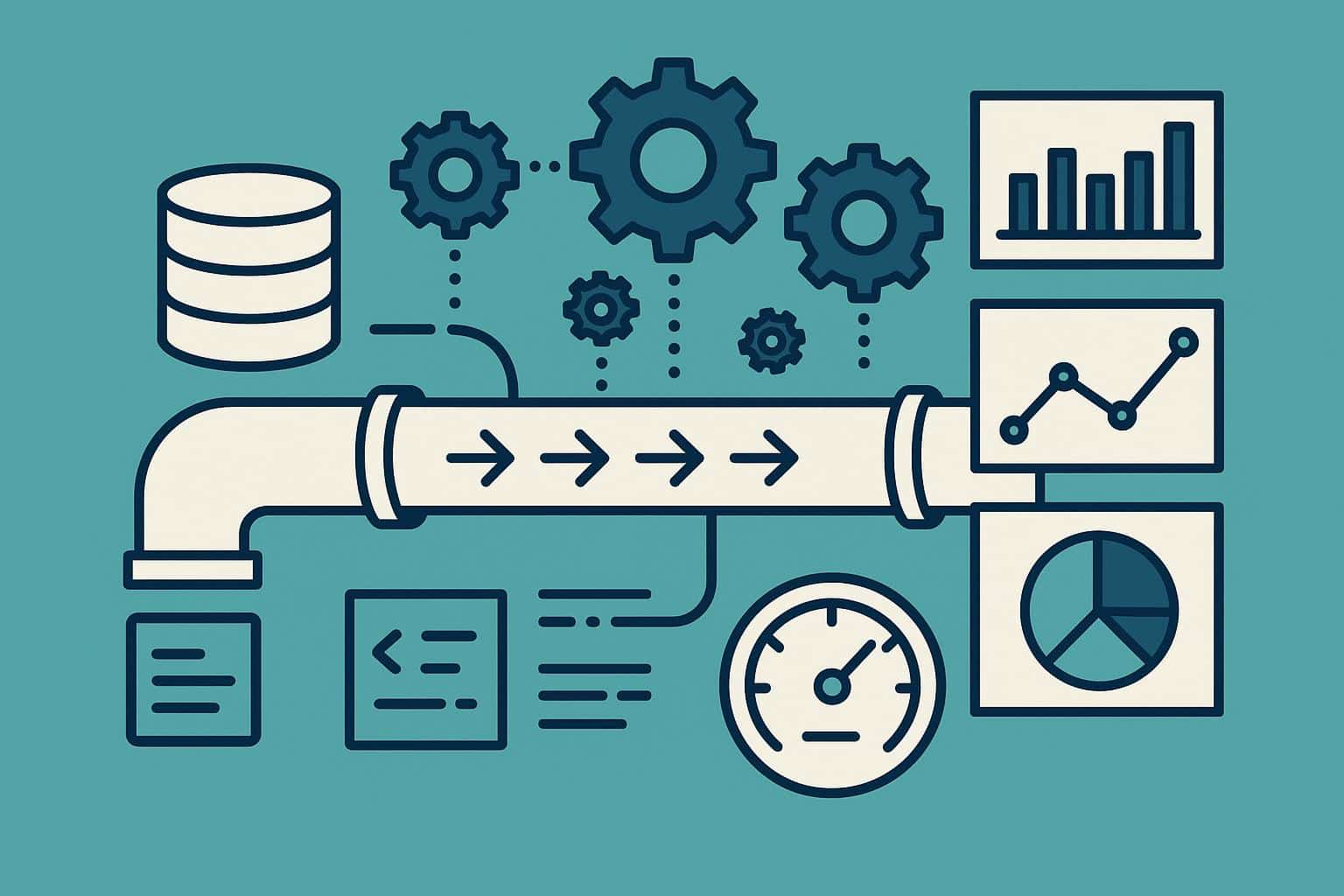
The work spans four areas: cost control, speed, resilience, and data quality; a practical set of pipeline optimization techniques that turn critical workloads into dependable, scalable systems.
2. Understanding Data Pipeline Optimization
Modern teams rely on data pipelines to keep information flowing between systems without delays or surprises. The idea is simple, but the moving parts make it feel closer to operations engineering than raw data work.
2.1 What Is a Data Pipeline?
A pipeline is a sequence of processing stages that moves data from sources to destinations while meeting freshness and quality expectations. Data can originate from application databases, event streams, sensors, or external APIs; it passes through validation, transformation, and routing before landing in analytics systems or storage layers.
Teams usually work with two models:
- Batch pipelines, which process accumulated data on a schedule.
- Streaming pipelines, which handle events continuously in real time.
2.2 Why Optimization Matters
Most organizations now struggle with sheer volume; 74% report being overwhelmed by data growth, and poorly designed pipelines make the problem worse. The result is predictable: rising cloud spend, latency that pushes decisions out of their useful window, and operational risk when pipelines fall behind.
At its core, data optimization means cleaning, refining, and organizing data so it is reliable and decision-ready. Data pipeline optimization carries that principle into practice, ensuring each stage of ingestion, transformation, and delivery runs efficiently and consistently.
2.3 DevOps & SRE Perspective
From an operations standpoint, pipelines behave like production systems. They need versioned infrastructure, continuous delivery, and clear SLOs around latency and freshness. That’s where DevOps and SRE disciplines sharpen the edges.
In well-run environments, DevOps and SRE teams treat pipelines the same way they treat core production systems: instrumented end-to-end, tested under strain, and tuned so they stay efficient instead of drifting into slow, fragile patterns.
This is also where broader pipeline optimization ties into the four pillars you’ll see next: cost, speed, resilience, and quality.
3. Optimization Pillar #1: Cost Efficiency
Cost is usually the first pressure point teams feel when their data pipeline grows. The workloads expand, storage fills up faster than expected, and the cloud bill starts creeping into uncomfortable territory. Most of the practical pipeline optimization techniques for cost fall into a few familiar buckets, but applying them consistently is what makes the difference.
3.1 Use Cloud Spot Instances for Non-Critical Tasks
For workloads that don’t mind interruptions, spare-capacity compute from major cloud providers can cut spending drastically. AWS Spot Instances and Google Preemptible VMs offer discounts of up to ~70% for the same performance profile.
These instances reclaim themselves with little warning, so they work best for batch ETL jobs, large historical reprocessing, or ML training runs that checkpoint progress frequently. Moving even a handful of these tasks can shave a large portion off compute spend.
3.2 Manage Data Across Storage Tiers
Not all data belongs on premium disks. Hot datasets stay in fast storage; everything else should move down the chain. Tiering and lifecycle rules (such as S3 Intelligent-Tiering, which shifts objects automatically based on access patterns) keep archival workloads cheap without impacting day-to-day operations.
3.3 Integrate Deduplication and Compression Tools
Duplicate records inflate both storage and processing time. This is one of the simplest data optimization techniques to implement. ML-based tools like AWS Lake Formation FindMatches identify near-duplicate entries, while compression reduces footprint with no loss. Edge Delta highlights deduplication and retention rules as core cost levers.
Many teams wire these checks straight into CI/CD so inefficient payloads never have a chance to slip into production.
3.4 Monitor and Predict Resource Utilization
Costs drop quickly once teams see what their jobs actually consume. Grafana, Prometheus, and CloudWatch expose usage patterns; dbt Labs showed that tuning a single slow model saved roughly $1,800 per month in Snowflake credits. Tracking cost-per-job and runtime hotspots guides the next round of fixes.
3.5 Enable Auto-Scaling
When workloads spike, capacity must follow, but only as far as needed. Auto-scaling keeps cloud resources aligned with real-time demand and prevents over-provisioning.
A useful approach here is combining cost-aware auto-scaling with real-time monitoring inside the cluster. Done well, it keeps utilisation aligned with demand and avoids paying for idle capacity.
This blend of controls turns cost management into a predictable part of infrastructure planning rather than a last-minute firefight.
4. Optimization Pillar #2: Processing Speed
Increasing the speed of a data pipeline isn’t about throwing more compute at the problem. The gains come from a mix of design choices, storage strategies, and execution models that remove friction from the flow itself. Most of the performance-focused pipeline optimization techniques fall into a few dependable categories.
4.1 Parallelize Data Processing
Sequential jobs are usually where the slowdown begins. Modern frameworks (Apache Spark, Apache Beam, Apache Flink) break large datasets into partitions and process them concurrently across distributed clusters. GeeksforGeeks cites parallelism, partitioning, caching, and efficient transforms as core performance levers.
If the transformations are independent, scaling out becomes almost linear. Sprinkle Data also highlights distributed execution and load balancing to avoid hot spots in heavy workloads.
4.2 Optimize Data Formats and Structures
Choosing the right file format can cut query time from minutes to seconds. Row-based formats like CSV force engines to scan everything; columnar formats such as Parquet and ORC read only the required fields and compress better. Data Engineer Things emphasizes columnar storage and breaking monolithic jobs into modular stages so each part can be tuned independently.
4.3 Adopt In-Memory Processing
Disk I/O adds milliseconds; memory access takes microseconds. For real-time dashboards, fraud detection, or event-driven systems, that difference matters. Keeping hot data in RAM with tools like Redis, Apache Ignite, or distributed caching layers cuts response times sharply.
4.4 Tune and Refactor Database Queries
Sometimes the bottleneck hides inside the warehouse. Indexing, partitioning, and caching reduce execution time; CI/CD pipelines can catch slow queries before deployment. This is one of the quieter data pipeline optimization wins, but it compounds quickly in analytics-heavy environments.
4.5 Stream Processing for Real-Time Insights
When events need to be available within seconds, Kafka or Pulsar becomes the backbone. Streaming removes the batch delay entirely and supports real-time personalization, alerting, and operational dashboards.
These environments are usually built on resilient, scalable Kubernetes-based pipelines, which is how large event systems keep pushing millions of messages per second without the whole stack buckling under load.
Speed-focused optimization relies on parallelism, smart formats, caching, and streaming; not just “more compute,” but a cleaner path through the system.
5. Optimization Pillar #3: Resilience and Fault Tolerance
Fast pipelines are easy to admire in a benchmark. What matters in production is whether they keep moving when something important fails. From a resilience angle, data pipeline optimization is about making sure a broken node, region, or dependency degrades behaviour gracefully instead of taking your whole data plane offline.
5.1 Design for Fault Tolerance and Redundancy
A resilient pipeline assumes that disks fail, zones go dark, and upstream systems misbehave. That’s why core components are spread across availability zones, with replication and failover paths defined up front rather than “to be added later.”
On the control-plane side, circuit-breaker logic and bounded retries prevent a flaky dependency from triggering a full cascade. Instead of hammering a failing service, the pipeline backs off, queues work where possible, and surfaces a clear signal in monitoring. Google’s SRE workbook is blunt here: reliability comes from explicit choices about availability, correctness, latency, and cost, not heroic firefights.
5.2 Run Real Stress Tests and Chaos Experiments
You only really learn how a pipeline behaves under pressure by breaking parts of it on purpose. Tools such as AWS Fault Injection Simulator and Gremlin let you inject latency, kill instances, or cut network links in a controlled way while you watch how ingestion, queues, and downstream jobs react.
The goal is simple: prove that your recovery time objective (RTO) and recovery point objective (RPO) are realistic. If a single region failure still produces data gaps or long catch-up windows, the resilience design is not finished.
5.3 Backup, Disaster Recovery, and Configuration Management
Backup and DR are part of pipeline design, not a separate compliance box. Snapshots without restore drills are noise. In practice, that means:
- Automated backups for critical stores, with regular test restores into isolated environments
- Versioned configuration and pipeline definitions, managed through Infrastructure as Code (IaC)
- Clear runbooks for failing over and failing back
Mammoth Analytics ties this together with a simple observation: logging, monitoring, DR, and configuration version control all sit in the same optimisation loop if you want to avoid repeating the same failures.
Many teams pair Kubernetes with GitOps-style workflows to mirror data infrastructure across availability zones, turning a single-region issue into a controlled failover instead of a full outage.
5.4 Continuous Monitoring and Alerting
Resilience without observability is guesswork. Each stage of the pipeline should expose at least:
- Latency and backlog (queue length, lag)
- Error rates and retry volumes
- Throughput and saturation for key resources
SRE practice formalises this through SLIs and SLOs, with SLAs where the business needs hard guarantees. In practice, teams extend SRE principles with round-the-clock monitoring and clear alert routing so signs of strain stay internal signals rather than customer-facing incidents.
6. Optimization Pillar #4: Data Quality and Observability
Trustworthy data is the part of the pipeline you only notice when it breaks. Everything else (speed, cost, clever engineering) takes a back seat the moment a dataset is wrong or incomplete. At this layer, data optimization becomes a business safeguard as much as a technical exercise.
6.1 Importance of Data Quality in Decision-Making
Executives often assume their dashboards reflect reality. In practice, the picture is far more uneven: only 23% of organisations report having a consistent data management strategy, and roughly 75% of business leaders don’t fully trust the data they use.
This is where reliability moves from engineering jargon to financial exposure. Bad joins, silent schema drift, or subtle distribution changes can mislead forecasting models, distort customer metrics, or trigger compliance problems. In short, unreliable data produces unreliable decisions, and the cost spreads quietly across the organisation.
6.2 Implement Data Observability Tools
Modern data stacks need observability that watches the data itself, not just the infrastructure around it. Anomaly detection should flag sudden spikes in nulls, missing partitions, distribution shifts, or unexpected volume drops. Lineage graphs make it possible to trace how a malformed field propagates through downstream jobs.
Platforms like Monte Carlo, Databand, and Great Expectations automate most of this work, providing the continuous visibility that Acceldata calls essential for data optimization at scale.
Xenoss’ breakdown of common pipeline failures underlines why this matters: data type errors affect ~33% of projects, integration issues ~29%, and ingestion/loading problems another ~18%. Observability is the safety net that catches these issues early instead of letting them erode trust weeks later.
6.3 Automate Validation and Testing in CI/CD
One of the cleanest data optimization techniques is treating transformations like code. Validation becomes part of the deployment path, not a post-incident audit. Typical checks include:
- Row‑count consistency
- Null enforcement on required fields
- Schema drift detection
- Distribution comparisons against historical baselines
When these tests run as early as commit time, bad data doesn’t quietly slip into production.
In mature setups, these tests sit directly inside deployment pipelines so quality checks run from the moment a change appears, not after a problem surfaces.
A practical example: catching a schema-drift error during a pre-merge test prevents an entire dashboard layer from breaking; a scenario that Acceldata points to as one of the most avoidable forms of downstream damage.
6.4 Build Feedback Loops and Ownership Culture
Data quality stabilises when teams own their part of the flow. That means real-time alerts that reach the right engineers, paired with the autonomy to fix issues at the source instead of relying on downstream patchwork. SRE-style error budgets help balance reliability with delivery speed, preventing “move fast” cultures from degrading quality with each iteration.
A reliable data setup usually blends observability, version control, and automated testing so datasets (moving or at rest) stay correct rather than drifting quietly over time.
Reliable data is not a bonus feature. It is the foundation on which data pipeline optimization actually works.
7. Measuring Success: Key KPIs for Data Pipeline Optimization
You can’t improve data pipeline optimization without knowing where the system bends, where it breaks, and where it quietly wastes resources. KPIs turn those behaviours into something measurable rather than anecdotal.
7.1 Core Operational Metrics
DataHub highlights throughput, runtime, freshness, and failure patterns as first-class indicators of pipeline health. In practice, that translates into a set of metrics most teams already track informally, just not consistently enough.
- Throughput: records processed per second; a direct read on capacity.
- Latency: how long it takes for generated data to become usable; the “freshness” factor.
- Failure Rate: the proportion of jobs that end in errors or retries, surfacing reliability issues early.
- MTTR (Mean Time to Recovery): how quickly a team restores normal operation after an incident.
These numbers form the backbone of performance assessment across the speed and resilience pillars.
7.2 Cost and Quality Indicators
Cost pressure shows up as cost per terabyte processed, a simple but revealing metric that confirms whether optimisation actually reduces spend rather than shifting it around.
Quality sits alongside it. A data quality score (built from validation checks, anomaly alerts, and schema-drift detection) gives teams a rolling view of trustworthiness over time.
7.3 Dashboards and Palark’s KPI-Driven Audits
Dashboards tie everything together. When throughput climbs, latency drops, or MTTR tightens, the improvement is visible in a way that both engineers and stakeholders can track.
A structured workflow often follows the same loop:
Measure → Identify Bottlenecks → Implement Improvements → Verify Sla Compliance
The approach is systematic, not speculative. A pipeline that’s measured well is almost always the one that improves fastest.
8. Common Pitfalls to Avoid
Even well-run engineering teams fall into recurring traps when trying to improve pipeline behaviour. The patterns aren’t subtle; they just tend to hide behind day-to-day urgency.
8.1 Where Teams Go Wrong
Ascend.io notes that pipelines fail when treated as static systems rather than evolving products. In practice, that shows up as:
- Chasing speed without cost or quality controls. Gains look impressive until cloud bills climb or dashboards break.
- Treating optimisation as a one-off rescue effort. Mammoth points out that systems decay when teams skip continuous monitoring and review.
- Over-engineering and tool sprawl. More technologies rarely equal more stability; they usually increase operational load.
- Ignoring observability and SLOs. Teams can’t fix what they can’t see.
- Poor collaboration between data engineers, DevOps, SRE, and business stakeholders. Misaligned expectations create fragile designs.
Conclusion
In most organisations, data pipeline optimization becomes a long-running discipline rather than a single project. The work only holds if engineering practice, automation, and culture move together. When they do, pipelines fade into the background; fast when needed, steady under load, cost-aware, and resilient enough to keep data flowing without drama.
Those four pillars (cost, speed, resilience, and quality) form a framework teams can return to as systems evolve. When engineering practice, automation, and culture move together, data infrastructure stops feeling like overhead and starts acting like a strategic asset in its own right.