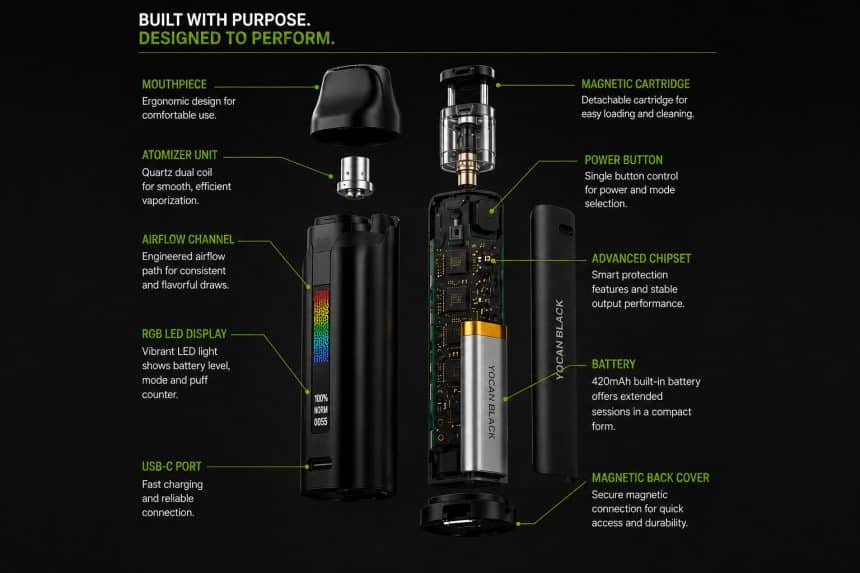
The trend toward smaller electronic devices usually creates a simple engineering problem: users expect more features, but there is less physical space available for the hardware that makes those features possible.
E-cigs are a useful example. A compact device may need to accommodate a rechargeable battery, charging hardware, a circuit board, switching components, sensors, user controls and a heating system inside a relatively small enclosure. Some devices also add displays, adjustable settings or more sophisticated monitoring.
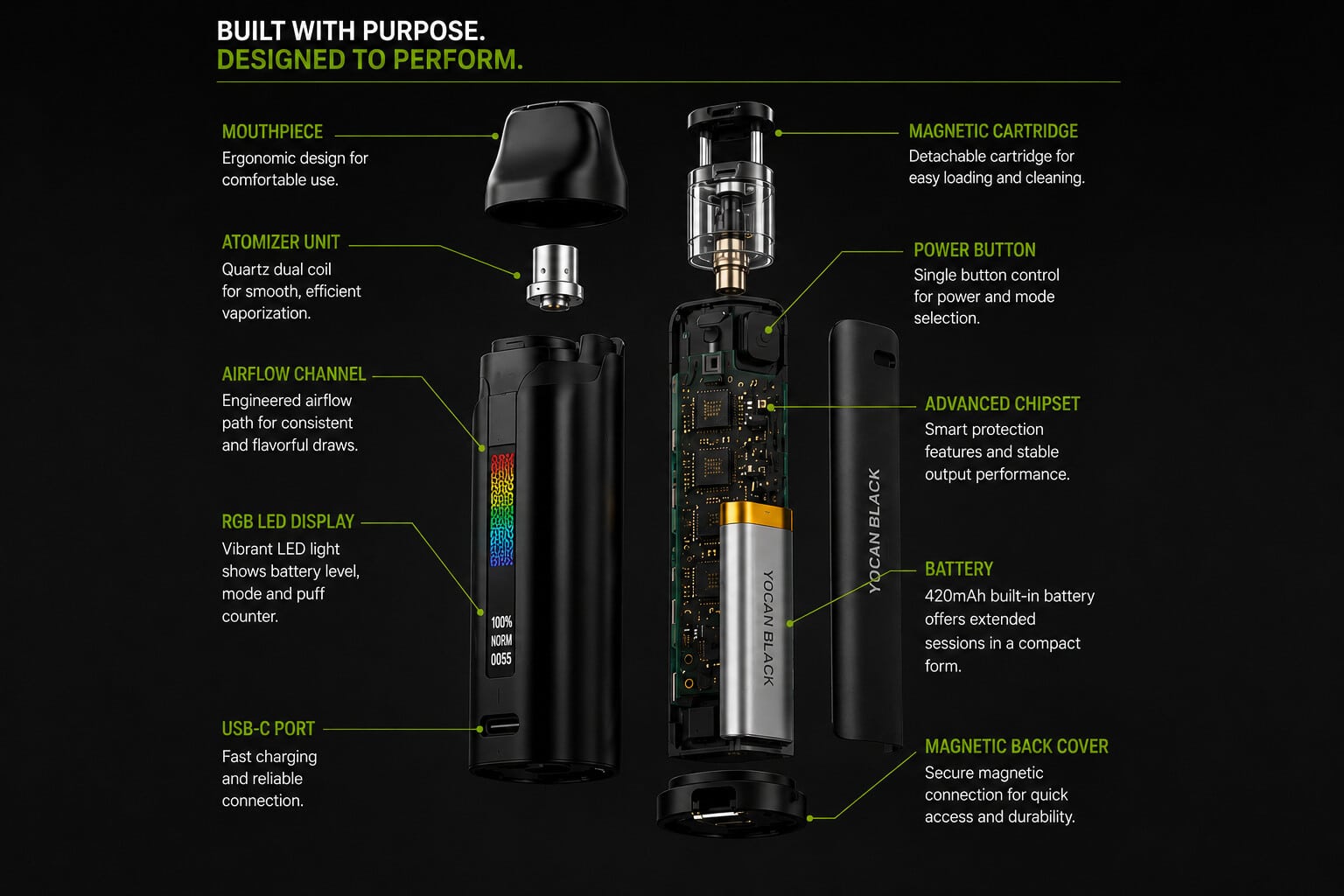
That does not mean every small e-cig uses the same technology. The internal architecture can vary significantly from one device to another. Still, the engineering challenge is broadly the same: fit the necessary components into a smaller space while managing electrical power and heat.
It Starts With the Battery
The battery is often the largest single component inside a compact e-cig.
Most rechargeable portable devices use lithium-ion battery technology because it provides a useful amount of stored energy relative to its size and weight. But shrinking the overall device creates an immediate compromise. A larger cell can generally store more energy, while a smaller enclosure limits how much battery capacity can physically fit inside.
Battery capacity is usually measured in milliamp-hours, or mAh. That figure is useful, but it does not tell the entire story about how long a device will operate.
Runtime also depends on how much power the heating element requires, how the device regulates its electrical output and how efficiently its internal electronics use the energy stored in the cell.
This is why two devices with similar battery capacities can produce different real-world results.
The Challenge of Managing Changing Voltage
A lithium-ion battery does not maintain one perfectly fixed voltage throughout its discharge cycle.
The voltage changes as energy is drawn from the cell. That creates a problem for devices that need reasonably controlled electrical output.
Rather than simply connecting the battery directly to the heating element, manufacturers can use electronic circuits to manage how power is delivered. Depending on the design, this may involve voltage regulation, switching components or other forms of power conversion.
A small circuit board can therefore have a major role in how the device behaves.
The battery provides the stored energy, but the control electronics determine when and how that energy reaches the heating system.
Small Circuit Boards Have to Do More
As devices become smaller, circuit boards often have to accommodate several functions at once.
A compact board may include components responsible for:
- Detecting button presses or other user inputs
- Controlling the flow of current
- Managing battery charging
- Monitoring electrical conditions
- Operating LEDs or displays
- Activating or deactivating the heating system
- Responding to certain fault conditions
More advanced designs may use a microcontroller to coordinate some of these functions.
This is one of the less visible changes in compact electronics. A device can have a simple exterior while relying on increasingly dense circuit-board layouts underneath.
Engineering is not necessarily about adding as many features as possible. In many cases, it is about deciding which functions can fit within the available space and power budget.
Power Regulation Makes Compact Devices More Predictable
Heating systems can place a relatively demanding load on a small battery.
Electrical power is commonly described by the equation:
P = V × I
where power is measured in watts, voltage in volts and current in amperes.
For a heating element, changes in voltage, current or resistance can affect the amount of power being delivered. Because the battery’s voltage changes as it discharges, control electronics can help manage that changing input.
Different devices handle this in different ways. Some use relatively straightforward switching systems, while others include more advanced regulation or multiple selectable power levels.
The important point is that the battery alone does not determine the device’s output. The surrounding electronics matter just as much.
Charging Hardware Has to Fit Into the Same Space
A modern rechargeable device also needs a way to safely replenish the battery.
That requires charging circuitry capable of managing the electrical relationship between the external power source and the lithium-ion cell. The charging circuit is not simply a wire connecting a USB port to the battery.
Lithium-ion charging generally requires controlled voltage and current. The charging electronics manage that process according to the requirements of the particular battery and device design.
USB-C has also made the physical side of charging more convenient for many portable devices. However, a USB-C connector alone does not indicate how quickly a device charges or whether it supports more advanced USB power features.
The charging speed depends on several factors, including the battery, charging circuit and power-management design.
In a compact device, fitting all of this hardware alongside the battery and heating system is part of the overall engineering challenge.
More Compact Hardware Also Means More Attention to Heat
Heat is unavoidable in a device built around an electrical heating element.
The heating component is designed to generate heat, but the battery and control electronics have their own operating limits. Engineers therefore have to consider how components are arranged inside the enclosure and how heat from one area may affect another.
The physical layout can matter as much as the individual components.
A battery placed near other heat-generating components may require different design considerations than one positioned elsewhere in the device. Materials, airflow, insulation and the amount of space between components can all affect how heat moves through a compact enclosure.
Not every device uses active thermal monitoring or sophisticated temperature feedback. Some rely on simpler operating limits and protection mechanisms. More advanced designs may include sensors that provide the control electronics with additional information.
The technology varies, but the underlying problem remains the same: more hardware in less space leaves less room for heat to dissipate.
Sensors Add Another Layer of Control
Sensors have become common across consumer electronics, although their use differs considerably between products.
In compact e-cigs, sensors may be used to detect airflow, button input, electrical conditions or temperature, depending on the design.
A device with an airflow sensor, for example, can detect a change in pressure when the user draws through it and use that signal to activate the electronics. A button-operated device may instead rely entirely on direct user input.
Temperature monitoring is another example where the details matter. Some products may use sensors or feedback systems to monitor particular components, while others may operate using predetermined electrical settings and timing.
It would be inaccurate to assume that every compact device has the same level of sensing or automated control.
Newer Hardware Shows How Dense These Designs Have Become
Recent products in the Yocan Black range provide one example of how manufacturers are approaching this problem. Current Yocan Black models include compact products such as the Pocket Mini and Pocket Full Travel Kit, alongside larger devices including the Celestial 2 and Phaser MAX 2. The Pocket Mini, for instance, combines a 1,300mAh battery, USB-C charging, an OLED display and adjustable temperature settings in a portable enclosure.
From a technology perspective, the interesting part is not simply the product category. It is the number of systems that have to coexist inside a relatively limited amount of space. Battery capacity, charging hardware, display components, control electronics and the heating system all compete for room, while the design also has to account for electrical and thermal constraints. The specific hardware varies between models, but the broader direction reflects a familiar challenge across portable consumer electronics: increasing functionality without allowing the device itself to become substantially larger.
The Smaller the Device, the More Important the Trade-Offs
There is no perfect combination of small size, high battery capacity, high power and low heat.
Improving one area can create compromises somewhere else.
A larger battery can provide more energy storage, but it requires more physical space. Higher power can place greater demands on the battery and switching components. Adding a display or additional sensors requires more space on the circuit board and may increase power consumption.
This means compact device design is largely an exercise in balancing competing requirements.
Engineers have to decide which features are essential, how much energy the device needs to store and how the available power should be managed.
The result is often a device that looks simple on the outside but contains a surprisingly complex arrangement of components.
Why Battery Size Is Only Part of the Story
Consumers often compare portable devices primarily by looking at battery capacity.
That can be useful, but it is only one part of the hardware.
A battery rated at a certain number of milliamp-hours stores a defined amount of electrical charge under specified conditions. How that stored energy translates into actual use depends on the complete system.
Power regulation can introduce energy losses. Different heating settings can require different amounts of power. Displays, LEDs and control electronics also consume energy.
A more useful way to think about battery performance is to consider the entire power system rather than the battery specification in isolation.
The cell stores the energy, but the rest of the hardware determines how efficiently and consistently that energy is used.
Component Placement Becomes an Engineering Decision
In larger electronics, designers generally have more freedom to separate components.
That freedom decreases as a device gets smaller.
The battery, charging port, circuit board, controls and heating components all need a physical location. Connections have to be routed between them, and the enclosure has to protect the components while still allowing the device to be assembled and serviced where applicable.
Modern manufacturing techniques allow circuit boards and electronic components to become extremely compact, but miniaturisation introduces its own difficulties.
Smaller layouts can make thermal management more challenging. Closely packed components can also complicate manufacturing and repair. Engineers have to consider not only whether a component will fit, but whether it can operate reliably in that position.
Software Can Also Play a Role
Not every improvement in compact hardware comes from changing the physical components.
Where a device uses a programmable controller, software can determine how the hardware responds to different conditions.
The controller may manage button sequences, session timing, display information or power settings. It may also determine what happens when the battery reaches a particular operating threshold.
This allows some functions to be handled through programming rather than adding separate mechanical controls.
A single button can therefore perform multiple tasks depending on how it is pressed. An OLED screen can display several pieces of information without requiring separate indicators for each function.
In this sense, compact device design increasingly depends on the interaction between hardware and software.
Miniaturisation Has Practical Limits
Technology can make components smaller, but physics still sets limits.
Batteries occupy physical space. Electrical components generate heat. Higher power requires components capable of handling the associated current and temperature.
As a result, making a device smaller is not simply a matter of shrinking every part.
Engineers often have to redesign the internal architecture around available space. A different battery shape, a more compact circuit-board layout or a revised arrangement of components can make a significant difference without fundamentally changing what the device does.
The challenge becomes even more complicated when the product is expected to remain portable and rechargeable.
The Technology Is Mostly Hidden
One reason compact e-cigs can appear technologically simple is that most of the important hardware is hidden from view.
The user may see a button, a charging port and perhaps a small display. Inside, the device may contain a battery-management system, charging circuitry, switching components, a controller and other electronics working together.
The level of sophistication varies widely between products. A basic device may use a relatively simple electrical design, while another may include adjustable settings, sensors and more complex control logic.
What they share is the same basic engineering challenge.
As portable electronics continue to shrink, designers are increasingly required to fit more functions into spaces that once held only a battery and a simple switch. E-cigs are one example of that broader trend.
The technology inside them is less about making the device look futuristic and more about solving practical problems: where to store energy, how to control it, how to recharge it and how to manage heat when everything has to fit inside a compact enclosure.