Technology does not always arrive with a touchscreen, an app, or a complicated interface. Sometimes it is simply a small motor, a power source, a set of moving parts, and a housing designed to make a repetitive task easier.
Electric herb grinders are a good example of this less obvious side of consumer technology. At first glance, the concept sounds straightforward: put plant material inside, activate the grinder, and let the mechanism do the work. But designing a compact electric grinder involves several engineering considerations, from motor torque and power consumption to blade or tooth geometry, heat management, vibration, materials, and ergonomics.
That makes these devices an interesting example of how relatively simple mechanical tasks can be transformed through modern product design.
What Makes an Electric Grinder Different?
A traditional grinder relies entirely on human input. The user turns two sections against each other, while teeth inside the grinding chamber break material down.
An electric design changes that equation by introducing a motor-driven mechanism. Instead of applying rotational force manually, the user activates a switch or button and the motor supplies the movement.
The underlying principle remains mechanical, but the source of energy changes.
That distinction is important. Adding a motor does not automatically make a product technologically sophisticated. The real engineering challenge is getting the motor, grinding mechanism, power source, controls, and enclosure to work together without making the device unnecessarily large or difficult to handle.
The Motor Is Only One Part of the System
When people think about an electric grinder, the motor is probably the first component that comes to mind. In reality, selecting the motor is only part of the design problem.
A motor needs enough torque to turn the grinding mechanism under load. At the same time, a larger or more powerful motor generally requires more space and can consume more electrical energy.
Designers therefore have to balance several factors:
- Available torque
- Rotational speed
- Battery or power requirements
- Physical size
- Heat generation
- Noise and vibration
- Expected operating time
This is the same type of trade-off found throughout consumer electronics. A manufacturer cannot simply maximize one specification without considering its effect on everything else.
Grinding Geometry Still Matters
Electric power cannot compensate for poor mechanical design.
The shape, spacing, and arrangement of the grinding teeth or cutting surfaces determine how material interacts with the mechanism. If the geometry is poorly designed, increasing motor speed may simply create more vibration or uneven results rather than solving the underlying problem.
This is where precision manufacturing becomes important.
A grinder’s components need to fit together consistently. The rotating and stationary sections must maintain appropriate clearances, while the housing needs to keep the mechanism properly aligned during operation.
In other words, an electric grinder is still fundamentally a mechanical product.
Battery Technology Creates Another Design Challenge
Portable electric grinders introduce another familiar piece of modern technology: the rechargeable battery.
A battery-powered device has to fit its power source into a compact enclosure while leaving enough room for the motor and grinding mechanism. Designers also have to consider charging electronics, switches, wiring, thermal behavior, and the overall weight of the product.
This is a miniature version of the same problem faced when designing wireless earbuds, handheld gaming devices, electric toothbrushes, and other rechargeable gadgets.
The smaller the product becomes, the more difficult it can be to fit everything together without compromising usability.
Vibration Is Both a Feature and an Engineering Problem
Movement creates another challenge.
A rotating motor naturally produces vibration. If the rotating components are not balanced properly, that vibration can become uncomfortable for the user and can also contribute to noise and mechanical wear.
Manufacturers can address this through component balancing, structural design, mounting methods, and careful distribution of weight.
Interestingly, vibration is not exclusive to motorized grinders. Some modern manual grinder designs also experiment with vibration-assisted mechanisms.
For example, SharpStone USA currently offers a 4-piece vibrating grinder alongside its conventional manual designs. The product sits somewhere between a traditional hand-operated grinder and a fully motor-driven device, illustrating how manufacturers can experiment with different approaches to reducing the effort involved in grinding.
That distinction is worth making because “vibrating” and “electric motorized” are not necessarily interchangeable descriptions. The mechanism and source of movement matter.
SharpStone’s Approach to Compact Grinder Design
SharpStone grinders current lineup also shows how much engineering can go into a product that does not contain a conventional motor.
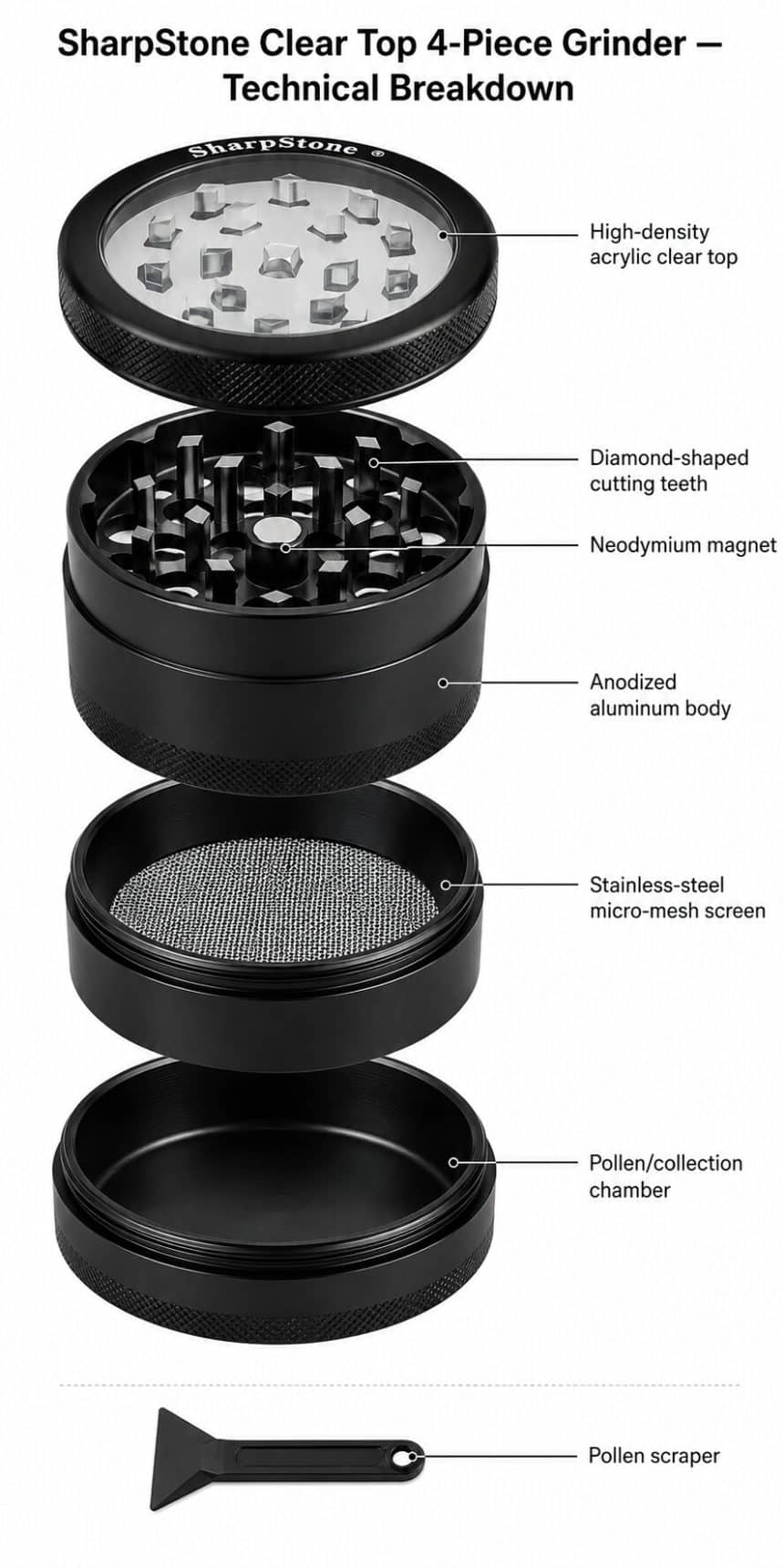
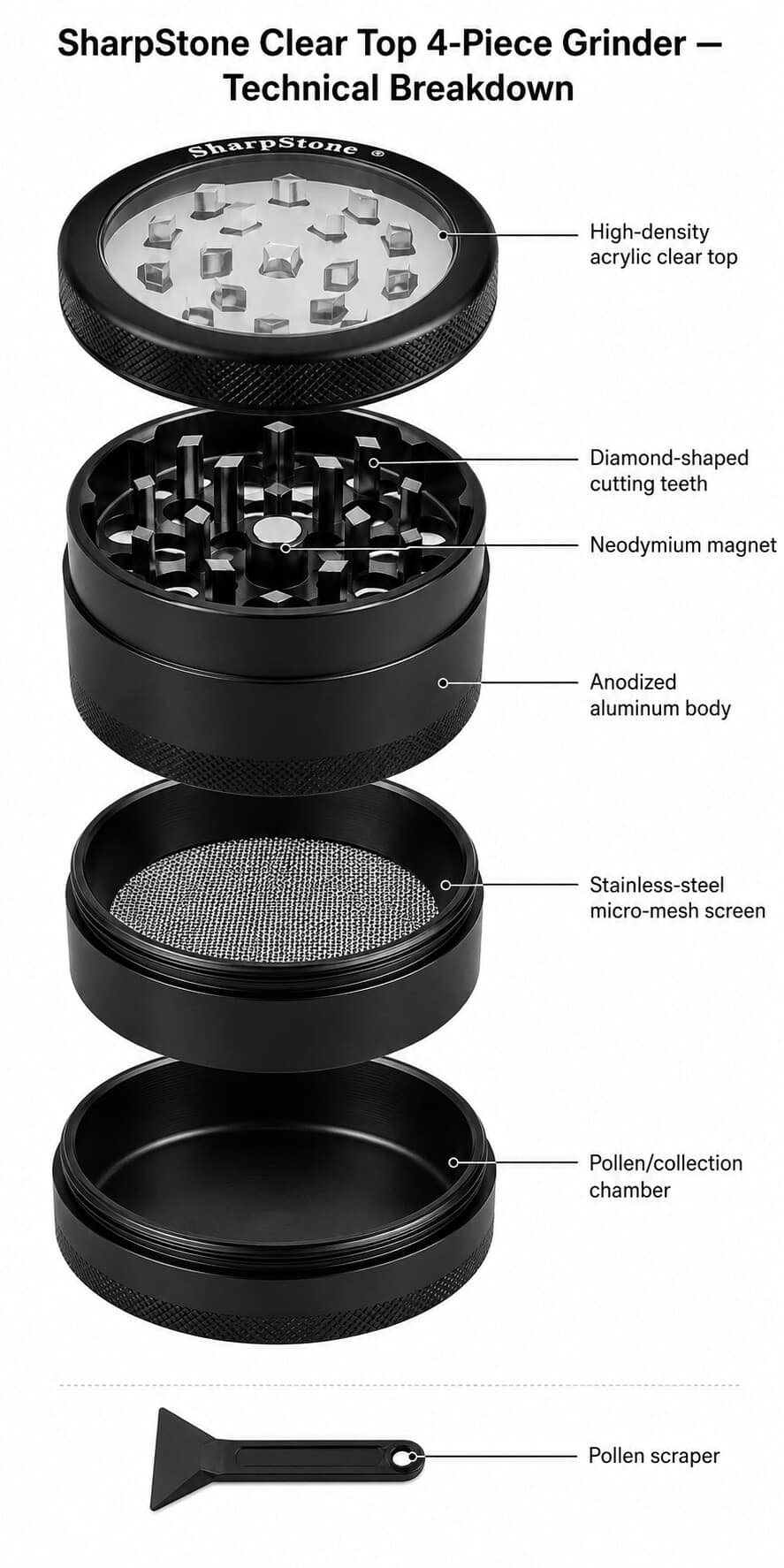
The company’s grinders include different configurations, including two-piece and four-piece designs. Its current four-piece models incorporate a grinding chamber, additional collection space, and a screen, while some models use a transparent top for visibility during grinding.
The company also sells hand-crank models, which introduce a mechanical transmission between the user’s hand movement and the grinding mechanism. That is another interesting example of product engineering: instead of adding electronics, the design changes the way force is applied.
SharpStone’s current V2 four-piece grinder, for example, is listed in two diameters, including a 2.1-inch medium version and a 2.5-inch large version. The company’s product information also describes CNC-machined aluminum construction and different lid configurations.
These details might seem relatively mundane, but they demonstrate an important point about consumer technology: good engineering is often about controlling small variables.
Why CNC Machining Matters
Precision machining is particularly useful when manufacturing components that need to fit together repeatedly.
CNC machining allows manufacturers to produce metal components according to programmed dimensions, helping maintain consistency between individual parts. For a grinder, that can matter for threads, teeth, mating surfaces, and the alignment of different sections.
SharpStone describes its grinder bodies as CNC-machined aluminum and uses precision-cut grinding teeth across its current range.
The concept extends well beyond grinders. The same manufacturing principles appear in camera components, computer hardware, automotive parts, medical equipment, and countless other products where physical tolerances matter.
Electric Does Not Automatically Mean Better
There is an understandable tendency to associate more electronics with a better product. But that is not always how good engineering works.
A manual grinder has an obvious advantage: there are fewer electrical components to maintain or recharge. There is no battery to monitor and no motor to fail.
An electric grinder, meanwhile, can reduce the physical effort required for repetitive grinding, but it introduces additional components and potential failure points.
The better option therefore depends on what the user actually needs.
Someone who values simplicity may prefer a conventional design. Someone who wants to minimize repetitive hand movement may find an electric mechanism more appealing.
Technology is useful when it solves a real problem—not simply because more technology has been added.
What the Future Could Look Like
The interesting future of electric herb grinders may not be about adding unnecessary smart features.
Instead, improvements are more likely to come from better motors, smaller batteries, improved power management, quieter operation, more efficient mechanisms, and better materials.
There is also room for experimentation with sensors. A future grinder could potentially monitor motor load and adjust its operation accordingly, although whether such features are useful enough to justify their additional complexity is another question.
That is the larger lesson from products like these. Consumer technology does not always have to be connected to the internet or powered by artificial intelligence to be interesting.
Sometimes the most useful innovations happen at the mechanical level.
The Bigger Technology Lesson
Electric herb grinders occupy an unusual corner of consumer technology, but the engineering principles behind them are surprisingly familiar.
They combine motors, batteries, mechanical components, materials, manufacturing tolerances, controls, and industrial design into a device small enough to hold in one hand.
The same design challenge appears in dozens of other products. Whether the object is an electric toothbrush, a handheld fan, a camera lens, or a compact grinder, engineers are constantly trying to answer the same question:
How can we make a small device perform a physical task reliably without making it unnecessarily complicated?
That is what makes electric herb grinders more interesting than they might initially appear. Beneath the simple exterior is a compact lesson in mechanical engineering, electronics, manufacturing, and product design.