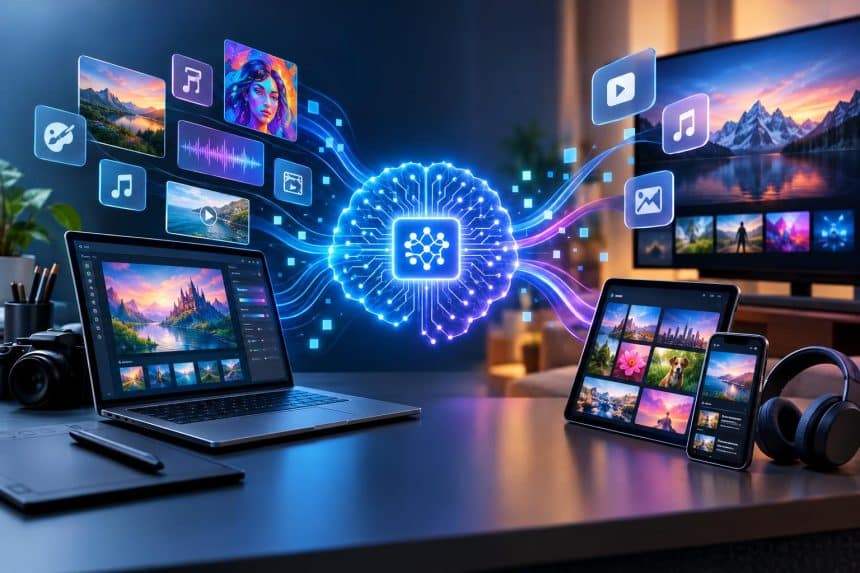
Artificial intelligence is rapidly changing the digital landscape, creating new opportunities for businesses, creators, and technology professionals. From generating visual assets to producing realistic audio, AI-powered technologies are making content creation more efficient and accessible.
As audiences increasingly consume information through websites, social media, videos, and audio platforms, organizations are exploring innovative ways to deliver engaging digital experiences. AI is helping bridge the gap between creative ideas and high-quality content by simplifying tasks that once required specialized skills and extensive resources.
The Evolution of AI-Powered Content Creation
Traditional content production often involves multiple stages, including research, design, editing, recording, and publishing. These processes can require considerable time, particularly for businesses that need to produce content regularly.
Artificial intelligence is helping streamline these activities through automated systems capable of generating text, images, audio, and other digital assets.
Instead of relying entirely on manual workflows, creators can use AI tools to develop initial concepts, explore creative directions, and produce content more quickly. This allows professionals to focus more on planning, originality, and audience engagement.
Transforming Visual Creativity With AI Image Generation
Images are an essential part of modern digital communication. Whether used in advertisements, blog articles, product presentations, or social media campaigns, compelling visuals help communicate ideas and capture audience attention.
An AI image generator allows users to create images from written descriptions, making visual content production more accessible. By entering a text prompt describing a scene, object, character, or artistic style, users can generate images that match their creative requirements.
This technology is particularly useful for:
- Digital marketing: Creating visuals for promotional campaigns and online advertisements.
- Blog publishing: Developing custom illustrations and featured images for articles.
- Social media: Producing creative graphics for different platforms and audiences.
- Product visualization: Exploring concepts and visual presentations before final production.
- Creative experimentation: Testing different styles, compositions, and artistic approaches.
AI image generation also gives smaller businesses and independent creators access to visual production capabilities without requiring advanced graphic design experience.
Making Digital Communication More Accessible With AI Text to Speech
Audio is becoming an increasingly important part of online content consumption. Podcasts, educational resources, audiobooks, tutorials, and video presentations are all examples of formats where spoken content plays a central role.
However, recording professional voiceovers can involve equipment, editing expertise, and considerable production time.
AI text to speech technology offers an alternative by converting written text into spoken audio using artificial intelligence. Users can provide scripts, articles, or other written material and generate audio versions without recording every sentence manually.
Some practical applications include:
- Educational materials: Transform written lessons into audio resources for students.
- Video narration: Add voiceovers to tutorials, presentations, and marketing videos.
- Accessibility: Provide audio alternatives for people who prefer listening to written content.
- Digital publishing: Convert articles and informational resources into audio formats.
- Customer support: Develop automated voice-based responses and informational systems.
Modern AI voice technologies can offer different speaking styles, languages, and voice characteristics, making it easier to adapt audio content for different audiences.
Why Combining Visual and Audio Content Matters
Digital audiences interact with information in different ways. Some prefer reading articles, others respond better to images, while many enjoy listening to audio or watching videos.
Combining visual and audio formats can help businesses create more flexible content experiences.
For example, a company publishing an educational article could use AI-generated illustrations to explain important concepts and convert the written material into audio for people who prefer listening.
Similarly, marketing teams can combine custom visuals with AI-generated narration to develop promotional presentations and informative campaigns.
This approach allows organizations to repurpose existing content across multiple channels without rebuilding everything from scratch.
Benefits of AI for Businesses and Content Creators
AI-powered creative technologies offer several practical advantages for organizations looking to improve their digital operations.
Greater productivity: Automated content generation can reduce the time spent on repetitive creative tasks.
Cost-effective production: Businesses can experiment with different content formats without investing heavily in traditional production resources.
Improved accessibility: Audio and visual alternatives make information available to broader audiences.
Content flexibility: Existing materials can be adapted into different formats for websites, social media, and digital campaigns.
Creative exploration: AI tools allow users to test ideas and develop new approaches without complicated production processes.
These benefits make AI especially valuable for startups, marketing agencies, educators, and independent content creators.
Important Considerations When Using AI Content Tools
Although artificial intelligence offers significant opportunities, it is important to use these technologies thoughtfully.
Generated images should be reviewed for accuracy, visual consistency, and relevance. Similarly, AI-generated speech should be checked for pronunciation, tone, and clarity before being used in professional projects.
Businesses should also consider copyright requirements, voice permissions, privacy, and transparency when publishing AI-generated materials.
Human involvement remains important because technology alone cannot fully understand every creative requirement, cultural context, or audience expectation.
The Future of AI in Digital Media
The relationship between artificial intelligence and digital media will continue to evolve. Improvements in image generation, speech synthesis, and other creative technologies are making it possible to develop increasingly sophisticated content workflows.
In the coming years, businesses may rely more heavily on integrated AI systems that connect visual production, audio creation, and other digital processes.
This evolution could make personalized content easier to produce while helping organizations communicate more effectively across different platforms.
Rather than replacing human creativity, these technologies can serve as valuable tools that help people explore ideas, improve productivity, and deliver better digital experiences.
Conclusion
Artificial intelligence is creating new possibilities for digital content production by simplifying the creation of visual and audio materials. An AI image generator can help transform creative descriptions into engaging visuals, while AI text to speech technology makes written information accessible through natural-sounding audio.
As these solutions continue to develop, businesses and creators will have more opportunities to produce diverse content, reach wider audiences, and improve their digital communication strategies. Combining AI capabilities with human creativity and thoughtful oversight will remain essential for achieving meaningful results.