Filed under: iTunes, Developer, App Store
App Store changes layout, threat of the fleshy palm still looms

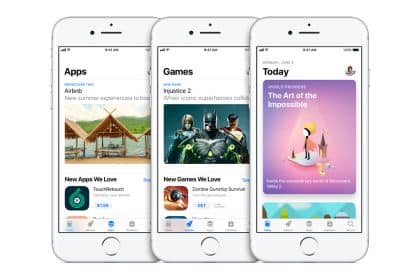
TouchMeme notes that the App Store has changed layout to separate free and paid applications, perhaps in response to developer grumbling about competition in a crowded market.
Free apps and paid apps now occupy sidebars to the right and left, respectively, of a major category index page. The center still allows you to sort the results by release date, name, or popularity (which doesn't appear to work yet: it only displays an alphabetical list). The separation of free and paid apps brings iTunes more closely in line with the mobile App Store experience. The changes affect every category except Games.
The concerns, though, of the Iconfactory's Craig Hockenberry (who earlier this week published an open letter to Steve Jobs detailing his frustration with marketing iPhone apps) may not be entirely assuaged. He argues that the price appeal of 99-cent apps (which may not be supported by the data) stifles the development of larger, more expensive apps that earn less prominent placement in the App Store.
The issues of price popularity and developer ROI aren't exactly solved by this furniture rearrangement, but perhaps it will let more high-quality apps bubble to the top of the Paid App charts. Otherwise, Apple might yet see the fleshy part of Hockenberry's palm.
[Via AppleInsider.]

![TUAW [Cafepress]](http://www.blogsmithmedia.com/www.tuaw.com/media/tuaw-cafepress-promo.png)


Reader Comments (Page 1 of 1)
Xerloq said 2:46PM on 12-12-2008
So I'm not sure I understand Craig's argument. Is he saying that he can't charge more because there is a competing cheap or free app that does the same thing?
Reply
Robert Palmer said 2:31PM on 12-12-2008
I think it has to do with the fact that many cheaper applications get more prominent placement (somehow) in the App Store. This may be related to their popularity, but Hockenberry notes that we don't really know the math behind how Apple calculates "popularity." I don't think it has to do with app-to-app competition.
For what it's worth, I have an email into Craig Hockenberry asking him to elaborate on what he means, among other questions.
Xerloq said 2:46PM on 12-12-2008
So it sounds like his issue is more with the way Apple promotes apps versus an issue with competition among devs. IMHO, the best apps, regardless of price should rise to the top, and expensive apps aren't necessarily the best - "I Am Rich" as my case in point. If the best apps are free, that promotes competition and gives incentive for the pay-for apps to improve. Wins all around.
I think buyers should understand how apps are rated and promoted in the store, but I'm against developers trying to exploit the system just so they can charge more, which is the ulterior motive I suspect is behind Craig's complaint.
Layton Duncan said 2:56PM on 12-12-2008
Perhaps this will clear up some of the confusion: http://www.improvetheappstore.com
Basically one of the major concerns that many developers have is that the current ranking system which is based primarily on download count, tends to drive app prices to the $0.99 mark (for reasons explained in the developer blog posts from the link above).
We personally have hard data to back this up for our apps. Instead of the current method, many developers would like to see the rankings driven by a number of other factors, including actual app revenue. That way the rankings are not skew disproportionately in favor of $0.99 apps. As Craig put it: "The thing we're hoping for is a way to rise above the competition when we do our job well, not just when we have the lowest price."
iTunes placement (either featured or top 100 lists) is the single biggest factor in driving app sales, it out performs reviews on sites like this, and others, by a long shot. External marketing $ are extremely hard to manage under this environment, it's a razor thin line between return and financial loss, for even relatively successful apps.
Of course there are other things we'd like to see improved, but it's safe to say that this is probably the most urgent, and one which I think will have a dramatic effect on the store for the better.
Xerloq said 3:44PM on 12-12-2008
Layton,
Thanks for the clarification - I especially liked your post on "The Hack Store." The big issue it seems is bigger than just the $0.99 apps getting on the Top 100 list - rather the commoditization of software as a whole. It's happening everywhere - not just the App Store.
You mentioned that users would be reluctant to shell out $5, $10, or $15 for an app they can test out - and I agree. But I contrast that with David Frampton's claim of $15 life changing apps - where are they?
A mechanism I would suggest (baring demos) is a way for consumers to return software. It seems like a radical idea (back-end support and enforcement notwithstanding), but that would provide a better mechanism to measure app attach rates (by measuring how sticky they are, which is an attempt to measure utility) and true popularity independent of price. You'd probably find a lot of the $1 apps are one-use-wonders, quickly forgotten.
Otherwise, devs will have to adapt, change the strategy of application development - like the rapid-update ideas suggested in the blog.
Prices will go to $1 regardless - it's a natural market force. The Top 100 list just accelerates it. But, as the App Store and iPod/iPhone platforms mature, you'll see some of those $15 stars begin to shine.
mabhatter said 1:58PM on 12-13-2008
The real issue is that the market has not demanded $29 apps yet. There may be developers wanting to make them, but the App store has only been in place 6 months. Devs need to prove to buyers that they NEED $29 apps.
I believe there is place for them, things like encyclopedias with lots of built-in professional content, or complex apps. But the iPhone really discourages large apps by design. People need to work up to it. Big ticket software like Photoshop and Autocad and Office all started with much more reasonable prices in a more crowded market. As the market grew up and those companies demonstrated features people wanted they got to charge more.
iPhone is new.. developer cred is reset to $.99. Some of those guys will be the next $29 app in few years, but EVERYBODY has an equal shot at it!! Many of these devs don't "get out of bed" for multiple times what the up-and-comers (living in their parent's basement) parent's make. iPhone is an "emerging" market, adjust your pricing accordingly and spend your experience building up good marketing so you're still around when prices go up. Develop the app people will buy NOW and grow it as more people get hooked.
Simon said 2:38PM on 12-12-2008
Is this only in the US-Store?
Reply
Johnny said 3:37PM on 12-12-2008
At first, I agreed (and I still see where he's coming from). Then, I was on the fence. Now, I really don't think there is anything Apple can do to fix this. I agree with someone else who said that the developer is responsible for marketing and Apple is responsible for distribution. Does this guy expect his app to go on top of the list because it is more expensive? No one can even solve the mystery of app acceptance, so how does one think Apple can decide who gets top listing based on anything other than download or revenue data? BTW, using revenue data would be a poor representation of anything to the consumer. So is he saying that Apple should not allow $.99 apps? Again, there is just nothing Apple can do any more fairly than it is. If you have a really great app that is worth more than $.99 or $9.99, you should do something to promote the app, just like any other software company does.
If your app is worth more than the $.99 variety, and you let people know it's there who are interested in high quality iPhone apps, they will buy it. The problem is, for him, that most people at the app store are not looking for professional apps, they're looking for the equivalent of freeware/shareware - just something to play around with. If you need professional software, like the Adobe CS of iPhone apps, then you will find the app and pay what it's worth.
Reply
Xerloq said 3:44PM on 12-12-2008
I totally agree. The market (App Store) is still very immature. As devs begin marketing activities, audience segmentation, profiling, etc., they'll be able to reach those inclined to buy their $15 products. The Top 100 list is just channel noise that any product marketer would have to cut through.
Johnny said 3:59PM on 12-12-2008
Ok, the one thing Apple could do, that would solve a lot of this, is allowing demos. I don't see why it would be so hard to allow a free (time or feature limited) demo on the same page as the full product. Then you could decide if it was worth the extra money and probably wouldn't even buy a lot of the crap you pay $.99 for. In the long run, Apple wouldn't lose anything they are making from these 'impulse' buys.
People buy $.99 apps because they don't really need the functionality it provides or care that much about the title and can afford to waste $1 to try it out. I have tons of these that I've bought and barely use, but it sure is cool to have them. ;-)
heytpn said 4:55PM on 12-12-2008
It's not that way for me. Is it because I have a PC? It's still the same!!!!!!!!!!!!!
Reply
vandil said 4:49PM on 12-12-2008
I have not purchased a single app. I seem to only download the free ones. Now if there was a good paid app that is a killer app for my needs, I'd certainly pay more than 99 cents.
The real problem is marketing. Counting on iTunes placement is suicide. You need to get your app in google search results and post cool demos on YouTube and pray someone blogs/Diggs it.
Reply
badweasel said 7:27PM on 12-12-2008
I think they need to now have categories for Free Apps, Apps under $1, Apps under $2, Apps under $3.. ..
That would give the good $5 apps exposure separate from the good $9 apps which would have their own section.
More sections will help sales overall - means more money for apple too. (and us :)
Reply
jh said 8:06PM on 12-12-2008
read this story about Appcubby's advertising effort,sounds like they are throwing money away...
http://appcubby.com/blog/files/financial_realities.html
Reply