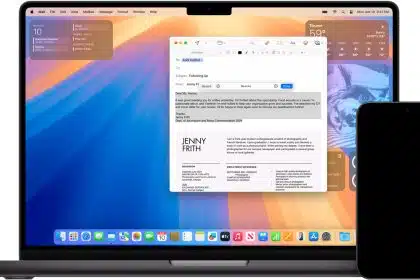
Over at Mac OS X Hints I recently ran into this doozy of a hint that I somehow missed on its first go around. Basically the idea is to capitalize on a great new feature in Leopard's help. You can get to any menu item without your mouse by activating the help menu with the keyboard shortcut ⌘ + ? (i.e. ⌘ + shift + /). Then type the name of the menu command you want and scroll down to it with the arrow keys. That command's menu will automatically drop down with the item highlighted, hit enter and you're done! If you're a keyboard maven this is a really easy way to get to your menu items (though you can also activate the menubar from the keyboard with ⌃F2).
iTunes has an update for the new iPod Classic and the new Nanos, and while the update doesn't have a description at all, MacRumors sez:
Improved CoverFlow
Quicker menus
And the much awaited video out fix, among a few other interface tweaks
Apparently there's a new option that will "Ask" users to output video when a compatible cable is connected. And some people say that the calendar and contacts will synch better as well, although I have the same reservations I have whenever I hear about unlisted feature updates -- if Apple did make it better, why didn't they want to tell us? Wouldn't they want us to know the iPod works better than ever?
At any rate, if you think it works better, then more power to you-- enjoy your updated iPod. As always, the update can be grabbed by connecting up your Classic or Nano to iTunes and hitting "Check for Updates."
Sure, those little icon utility menus on the right side of the screen -- displays, sound, Airport, etc. -- are handy, but do I really need the Displays icon there for a desktop screen that never changes size, or the Modem icon when I've got broadband? While you can deactivate most of these through a parent application or System Preferences, there's a quicker way: simply hold down the Command (Apple) key and drag the offender out of the menu bar and onto a blank area of the Desktop. Poof! No more icon.
I'm not a huge fan of color in the menu bar, but that probably stems from the fact that I'm not a huge fan of color in the rest of my operating environment (and why I use the graphite visual style). However, it seems that there are a good many people want their OS to look like it was made by Fischer Price, and that's where iColon and MenuPics come in. These two applications both do exactly the same thing; add a dash of color to the otherwise drab utilitarian menu icons sitting in the top-right corner of your screen. The only real differences between the two are universal binary status (iColon is, MenuPics isn't) and how many customization options they give you (iColon only adds color to the normal Bluetooth, Airport, and Battery Meter, while MenuPics gives you the choice to change the icons all together.)
A macosxhints post details how browsing the iTMS (as some might assume) works quite a bit like Safari. The poster discovered that clicking and holding on either the forward or back button in the iTMS will reveal a drop-down history menu. This ought to make browsing a bit easier for the chronic iTMS user (just don't blame us for the bill).
I also noticed a little while ago that the standard Safari keyboard shortcuts of cmd + [ or ] will act as a back/forward command in the iTMS as well. Now all we need is bookmarking ability and a del.icio.us-like system for publicly marking and sharing albums for fellow users, and we'll be all set!
Macintalk has posted a how-to on enabling a really slick Constellation menu plugin for Quicksilver β49. Granted, this menu is quite a bit of eye candy, but if you follow Macintalk's post all the way through and assign this menu to a hotkey, it then becomes a bit of really handy eye candy.
Keep in mind, however, that (as far as I know) you need the latest developer β49 to bring this plugin to fruition, so just like with the last slick Quicksilver Cube eye candy plugin, if you're not interested in the beta side of things, you should probably leave this one alone until it gets ironed out a bit more...
...but on the other hand: look at how cool that is! The entire thing is clickable, and it's also bigger in 'real life' - on my 1440 x 900 display it's 512 x 512 pixels, so it's much more legible than the 225 x 225 screenshot in this post. The small button just to the right of the iTunes icon in the middle of this menu, for example, displays a popup list of your playlists. Clicking on any of the larger slices, such as the albums or artists, pops up a second, similar menu you can browse through by using the down arrow at the bottom of the inner circle. The whole menu system seems pretty zippy too, once it takes a second to load all your iTunes information. Of course, I'm also using a 2.0 Ghz MacBook Pro with 1.5 GB RAM, so YMMV. Check out Macintalk's how-to if you're done drooling and want to get down to business.
CamiScript, the script menu plugin for Camino, has been updated to version 4.0. This isn't quite a landmark release that enables Camino to fly around your room or tell you the future (besides, some day, the latter will be Google's job), but this new version does bring one big handy new feature: the ability to disable/enable the Extras menu.
CamiScript is free and can be had from nadamac; oddly, PimpMyCamino hasn't updated yet.
Hot on the heels of brining Universal status to their Application Enhancer, Unsanity has released UB versions of ClearDock (free) and Menu Master ($10). ClearDock, as you might glean from the name, is a one-trick pony that can strip the dock of its transparent background or allow you to adjust the background and the application triangle color to your liking. Menu Master is a slick utility for assigning, removing and rearranging shortcuts for menu items in any Mac OS X application. It also has a Menu Accelerator feature which allows you to "access menu items by name without using the mouse". Both applications have received feature additions and improvements, as well as bug fixes along with their UB updates.
ClearDock again is free, while Menu Master has a demo available, and a license will run you $10. Both require the previously mentioned Application Enhancer in order to work their magic on your Mac.
Like Tim Gaden over at Hawk Wings, I too love Mac OS X's highly underrated Services menu, and Robert Stainsby has released a very handy addition to it: MappingService. This clever service allows you to select an address from any application, say a website, a document or an IM, and simply chose 'Map' from your Services menu to generate a map in any one of three mapping services: Google Maps (of course), ZoomIn Australia or ZoomIn New Zealand.
MappingService is known to work on 10.4.6 and might possibly work on earlier versions of Mac OS X. It is open source software released under the BSD license, and Robert is accepting donations for his fine work.
I'm not sure when it turned, but Service Scrubber has become a Universal Binary. We've mentioned this slick utility before, but in case you're unfamiliar, Service Scrubber allows you to do three fundamental things with that powerful, but seldom used, Services menu underneath your active Application menu in the menubar:
restructure the services menu
change service keyboard shortcuts
disable services
It's a very handy utility, especially for those of you who like to tinker with lots of different apps and utilities and suddenly find yourselves overrun with services.