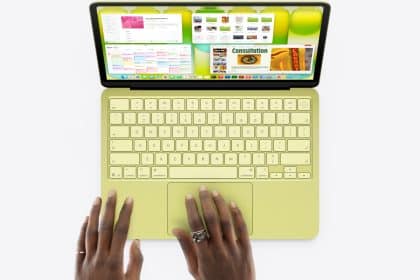
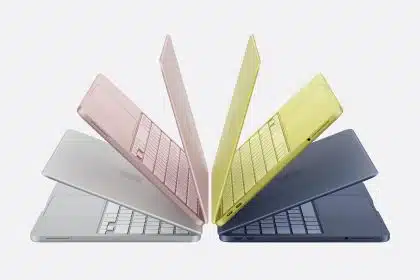
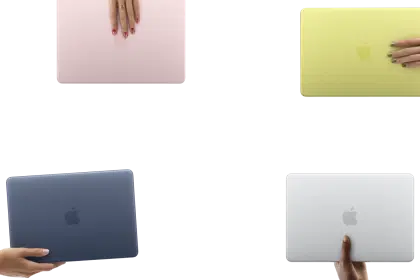
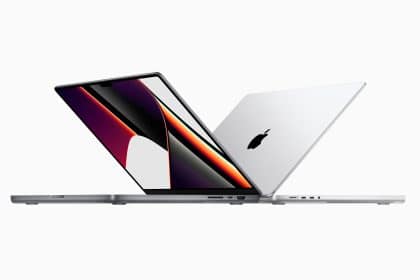
I can't stop talking about the MacBook Air. It's so thin, so light and so gosh-darn sexy (in the way that only a machine shaped like a two thousand-dollar toilet lid can be). Since the topic seems to have worn thin with my kids -- my 4-year-old insists that the lack of a Firewire port is ludicrous and my 2-year-old is threatening to "...go Edubuntu" just to spite me -- I'm going to share my thoughts with you.
Adam Lisagor got it right when he called the Air "...a conceptual shift in personal computing." As has happened many times before, Steve Jobs has seen the future. He knows where technology is going, and he knows what you and I will need when we get there.
Specifically, the computer will become a mobile access point for all of your stuff, not a bulging brief case. With your documents living off-site, all you'll need is an interface between you and your "weightless data." A portable, hyper-wireless machine is it.*
People will resist. Remember in 2000 when Apple asked us to fit an 8" cube into a slot previously occupied by a bondi-colored canned ham? People balked, and the Cube was discontinued a little more than a year after its introduction. Still, Apple knew that small computers would have a place in the market. Such is the case with weightless data.
I've placed my files into five categories:
- Documents
- Media (music and movies)
- Photos
- Contacts
Each can easily be stored online. Let's start with documents.
I have three types of documents: "Reference," "Support" and what I call "Open." Reference documents - like serial numbers and retail receipts - don't require me to do anything, but may be useful in the future.
Support documents are specific to a project. For example, while writing this post I researched online storage solutions. That information became the support documents for this article.
Finally, "open documents" are things I'm actively working on, like blog posts, articles and so on. This post, for example, was an open document whilst I prepared it for publication.
Here's how I use each type online.
Online Storage
All of my documents live on my Apple iDisk (There are many online storage options, like BingoDisk, .Mac, and Amazon S3). I've created two folders on my iDisk: "Reference" and "Support." They contain twenty six folders each, labeled "A" through "Z" - a simple alphabetic filing system. Within the "Reference/R" folder is another folder labeled "Receipts," where I keep records of online purchases. Within the "Support/T" folder is another labeled "TUAW," where I store research for articles. I consider my iDisk an electronic filing cabinet.
So what about the open documents? Read on.
Online Productivity
I write all of my articles with ThinkFree, an online alternative of Microsoft Office. It feels like Microsoft Word, and lets you store, categorize and tag your documents. You can export to familiar formats (like Word, Excel and Powerpoint) for sharing with others, and features like spell check and type styles (italics, bold, etc.) work as you'd expect. I can access those files from any computer, at any time. Best of all, it's free.
I love browser-based email providers. With Gmail, .Mac and the magic of IMAP, my messages live online, and not on my computer.
Bookmarks
I'd be lost without my web bookmarks. As a Firefox user, I've installed Google's Browser Sync plugin. It stores my bookmarks on Google's servers, and updates the list automatically as I make changes. Also, changes I make on one computer will show up on another, so everything is up-to-date.
Contacts
I tried to keep my Gmail and .Mac address books up-to-date, but it was a pain. So, I use 37Signal's Highrise, which lets me manage contacts, keep track of exchanges, schedule tasks and more. If I "lost it all" at home, my contact information would be waiting for me at Highrise.
Photos
I use Apple's iPhoto to mange my digital photos. The photo library itself lives on an external drive connected to my computer. My favorites get uploaded to Flickr in their full-resolution glory. The bonus is If my computer died tomorrow, I'd be able to connect my external drive to a new one and retain all of my photographs. If the external drive died as well, I could download my favorites from Flickr.
Music and Movies
As with photos, my music and movies live on an external drive connected to my computer. I also use a service called Bandwagon to keep all of those files backed up. For $12US/year, you can enjoy automatic backups of your entire iTunes library, as well as synchronization of those files across two computers. Now that's a deal!
So there you have it - all of my beloved files, safely stored off of my computer, available anywhere. Weightless data.


Reader Comments (Page 1 of 3)
1-22-2008 @ 9:13PM
draper said...
Just for reference, the bandwagon site is not currently accepting any newcomers. I'm quite disappointed...
Reply
1-22-2008 @ 9:16PM
JGO said...
I completely agree with your 4-year old!!
Reply
1-23-2008 @ 5:20AM
robogobo said...
Smart kid. He's the future.
Why Apple keeps dropping Firewire just as third party developers begin wide support of it is beyond me. USB is so annoyingly quirky, slow, and underpowered. What do I do when I can't get enough bus power to run my portable HD that I have to carry everywhere because my 80gig internal filled up the first day of use? HUH? Apple?
1-22-2008 @ 9:39PM
Rick said...
Apple will forever be getting $99/year simply because of the iDisk. I just love that every document I've ever written is accessible from anywhere. Of course, I know there are other online storage solutions out there, some of them free, but iDisk's ability to automatically sync to the hard drive of each my computers (for offline access as well) is just fantastic. Now if I could only manage/email those documents from my iPhone....
Reply
1-22-2008 @ 9:40PM
Fernando said...
Smart kids you got there
Reply
1-22-2008 @ 9:52PM
Apple Fanboy #3782 said...
Smart kids!
Reply
1-22-2008 @ 10:01PM
Rick said...
Dave, how do you access your Highrise contacts while not connected to the web? Does it sync with your Address Book somehow?
Reply
1-22-2008 @ 10:12PM
ribminster said...
Is an 80GB hard drive really indicative of Apple's shift towards users keeping all of their documents living off-site? I suppose the corresponding updates to .Mac might.. Wait, there wasn't an update to .Mac..
Reply
1-23-2008 @ 2:23AM
FL said...
Time Capsule is another proof that Apple is eying truly wireless computing and is a great companion to MBA. Besides data, peripherals should be wireless too. There are already wireless cameras and printers that can be used with MBA without cables.
Or, you can buy a Keyspan USB Server (http://www.keyspan.com/products/u2s2a/) that bridge USB devices through an Ethernet interface, which then can be hooked up to a Wi-Fi router. Thus you may access your scanner or camera over Wi-Fi! Silex and Belkin have something similar I believe.
Another technology to watch is the Wireless USB (WUSB). Windows has supported it for a while and Mac support should come sooner or later. When it does, the MBA user can buy a WUSB dongle plus a WUSB hub such as this D-Link product set (http://www.dlink.com/products/?sec=0&pid=629) and access all his or her USB devices wirelessly.
1-22-2008 @ 10:13PM
Scott said...
I think what people need to understand is that the MacBook Air is built for people who already have a desktop at home. You don't NEED firewire on a laptop if you've got a desktop that supports it, and if you NEED firewire and don't have a desktop, then buy a MacBook or a MacBook Pro. It's not like they discontinued the other models in favor of this one.
Reply
1-22-2008 @ 10:40PM
Jay said...
Am I the only one who thinks the MacBook Air is the single most disappointing Apple product of the past few years?
Enough about your justification in buying one. I'm a mac enthusiast, and might buy a new computer or a new iPod when my old one dies. You sound like you're buying one just to play around with it. I won't tell you how to spend your money, but I think that's one hell of a giant waste.
Reply
1-23-2008 @ 5:12AM
robogobo said...
you're not the only one.
1-23-2008 @ 4:28PM
squiggle said...
FFS get a life...
The MacBook has a specific purpose it is not meant to totally replace what you have at present (Desktop/Notebook).
If you think it is a disappointing product then you obviously are not the market segment that Apple is targeting.
1-22-2008 @ 10:52PM
Johnathon Zirkle said...
I love watching that G4 Cube video. Listen to how Steve pronounces component. And the crowd gets a little excited over the stupid handle in the bottom...
Reply
1-22-2008 @ 10:52PM
Johnathon Zirkle said...
I love watching that G4 Cube video. Listen to how Steve pronounces component. And the crowd gets a little excited over the stupid handle in the bottom...
Reply
1-22-2008 @ 11:15PM
Reality said...
I love Apple. I really do- I have a MacBookPro, AppleTV, Might Mouse, and two iPods. But this thing is RIDICULOUS. Apple has yet again sacrificed usability for visual appeal, and it doesn't even have 3G HSDPA support. All tell you what's in the air, but it ain't pretty.
Reply
1-22-2008 @ 11:35PM
Jim Delaney said...
But what Apple may not really `get' is that fully embracing weightless data makes swank and expensive hardware less appealing. Since recently and somewhat grudgingly moving most of my work online I have been finding that my two computers--a MacBook and an age-old Toshiba running Ubuntu--are pretty much equal. Firefox actually runs better on Linux. The only piece of software that I regularly use other than Firefox is a text editor, which leaves me with the only real reason that I sigh when switching to work at home on my Mac: Textmate.
Reply
1-22-2008 @ 11:47PM
LD said...
I think Apple is onto something, but it's nothing new. And I think the current iteration is going to fail, just like the Cube.
That doesn't mean it's a bad idea, it's just poor execution. It's trying to push the state of the art, and it's moving in the right direction, it's just missing key features. Just like the Cube was lacking in certain key areas.
It's too big. Yes, the Air is too big. Screen should be smaller, making it even more portable. It should have more battery life than my MBP, it doesn't. It should be solid state, it isn't. It should be $999. Yes, $999. Someone suggested making it iPod-like and syncing it to your main Mac/PC. I think that's a fantastic idea, but they didn't do it.
They could have an amazing, new spin on technology. Instead, all we get is more of the same in a slimmer package. That's neat, but not that interesting or innovative.
Reply
1-23-2008 @ 1:24AM
Enough said...
Everyone, seriously, please stop comparing MBA to Cube. MBA is more like the iPod mini. Lots of people (me included) hated with passion when it was introduced. They complained that it was too expensive, not enough HD space, not small enough, sacrificing usability, etc., etc. Similar backlashes were given to the original iMac as well. They only went on and became the most popular products ever.
What the critics ignored was that form factor can be a benefit in and of itself. And sometimes reducing features actually improves effectiveness. Cube failed because it made things more complex than they should, while its size reduction meant little to a desktop. For a laptop, weight and size do matter.
Apple is smart enough not to sacrifice the size of screen or keyboard because this is a full feature computer. For you who's been screaming that MBA should've been an even smaller satellite computer, I'm fully convinced that Jobs wants you to use the iPod touch, iPhone, or the future multi-touch tablet for that. Exhibit A: During yesterday's Q1 conference, Apple executives called iPod touch "first mainstream Wi-Fi mobile platform."
So it seems to me there is a roadmap that Apple is holding close to its chest. Whether it will succeed may be too early to tell. However, simply dismissing MBA as a thoughtless, useless hyped product that has more style than substance (haters, am I missing anything here?) is an overly simplistic view.
1-23-2008 @ 5:11AM
robogobo said...
Enough....
No, the mini didn't become the most popular. They don't even make it anymore. It was replaced by the Nano, which was small enough, and not too expensive. The same will happen to the MBA when it fails. It will be replaced by something that we can actually use and afford.