An agent demo is a beautiful thing. You type a request, watch the model reason through a plan, call a few tools, and hand back a clean answer. On your laptop, in a fresh terminal, with you watching, it works every single time. Then you ship it — and within a week you are staring at a Slack thread titled “is the agent down?” that nobody can answer. For the full comparison behind it, see the guide to AI agent platforms to run agents in production.
This is the most predictable disappointment in applied AI right now. The failure is rarely the model. The model is usually fine. What breaks is everything the demo quietly assumed: that a human was watching, that the process would never be killed, that memory lived in RAM forever, that nobody would ever ask what the agent actually did. Production removes those assumptions one by one, and each removal exposes a distinct failure mode.
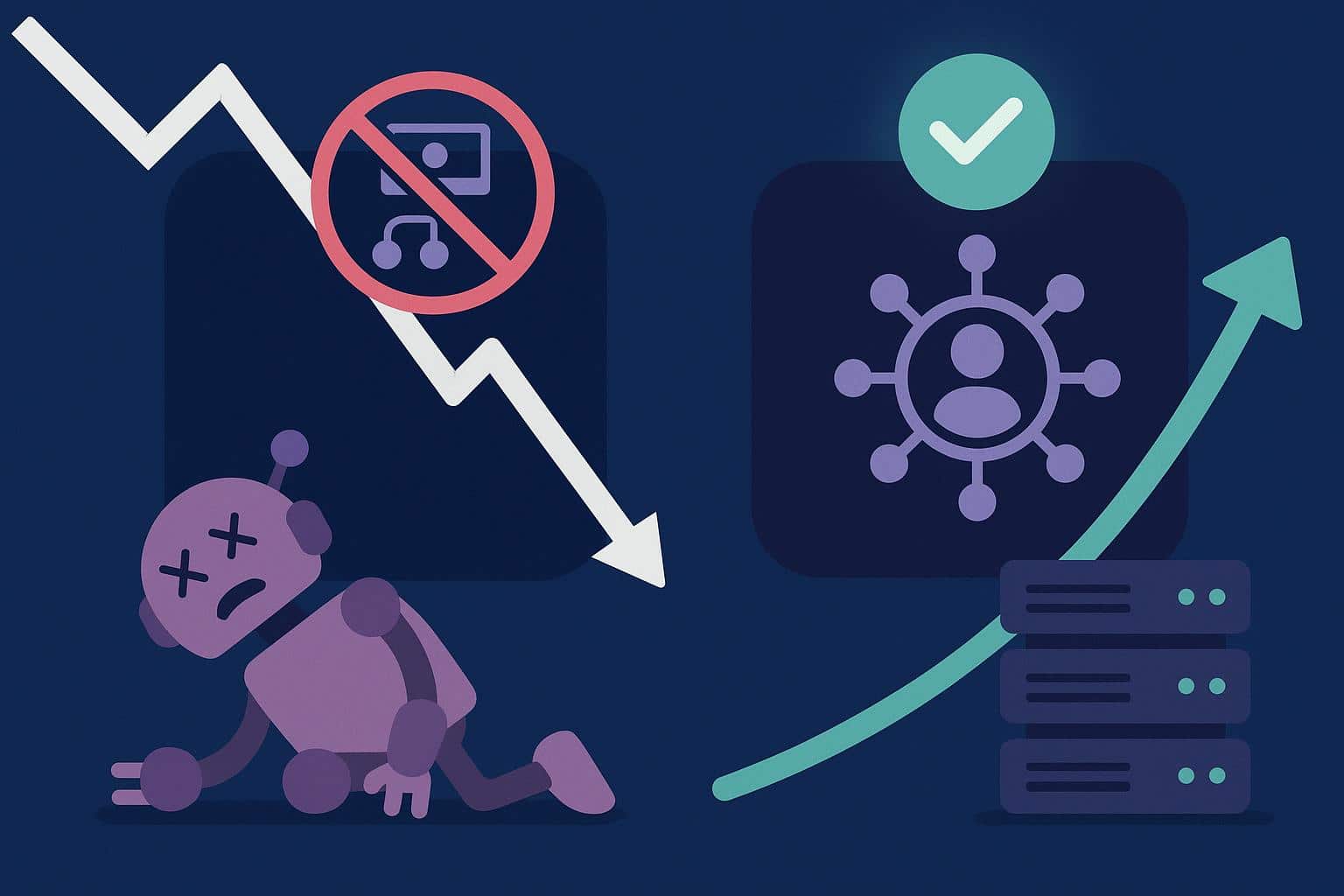
The numbers say this is not a niche problem. Gartner projected in June 2025 that over 40% of agentic AI projects will be canceled by the end of 2027, citing escalating costs, unclear business value, and inadequate risk controls. A widely cited 2025 MIT report on generative AI in the enterprise (the NANDA “State of AI in Business” study) found that roughly 95% of enterprise GenAI pilots delivered no measurable return — most never crossed from pilot into durable production use at all. The gap between “works in a notebook” and “runs the business” is where these projects die.
This article walks through the specific ways an agent that works on a laptop breaks once it is unattended, and — critically — which *categories* of platform actually solve each failure. Not every tool in the market is trying to solve the same problem, and confusing a compute primitive for an operating platform is itself one of the reasons projects stall.
Failure mode 1: The crash with no recovery
A local agent runs inside one process. You start it, it does its work, it exits. If it dies halfway through — an API timeout, an out-of-memory kill, a transient network fault — you just run it again. No harm done, because you were there.
In production, “run it again” is a decision nobody is available to make at 3 a.m. And re-running a partially completed multi-step task is often worse than not running it at all: the agent already sent the email, already wrote to the database, already charged the card, and a naive restart does all of it twice. What production needs is *durable execution* — the ability to resume a long-running process from where it stopped, exactly once, without replaying side effects.
This is precisely the problem Temporal was built to solve. Temporal is a durable-execution engine: it persists the state of a workflow to a backing store so that if a worker crashes, the workflow resumes deterministically from its last completed step. It is genuinely excellent at this, and if your agent is really a long, branching workflow with external side effects, a durable-execution layer underneath it is a serious upgrade in reliability.
But it is important to be accurate about what Temporal is. Temporal is a reliability *primitive*, not an agent platform. It gives you exactly-once execution semantics and retry orchestration; it does not give you an agent runtime, a memory model, tamper-evident auditing, or a place for a non-engineer to see what an agent is doing. You wire your agent into it, and you still own everything above the workflow line. That is the right tradeoff for some teams and a lot of undifferentiated engineering for others.
Failure mode 2: Amnesia across restarts
On a laptop, an agent’s memory is whatever lives in the Python process — a list of messages, a scratchpad, a vector store you spun up for the session. Kill the process and it all evaporates. During development that is invisible, because a “session” and “the whole run” are the same thing.
Production separates them. An agent that supports a workflow over days or weeks needs to remember what it learned last Tuesday. When it restarts — for a deploy, a crash, a scaling event — it must come back knowing what it knew before. If it does not, you get an agent with anterograde amnesia: competent in the moment, useless as a compounding asset, re-deriving the same context every morning and occasionally contradicting yesterday’s decision.
Solving amnesia means state has to live *outside* the process, in durable storage the runtime reloads on boot. Frameworks in the stateful-agent category address this directly. LangGraph Platform — the managed deployment layer paired with the LangGraph framework — persists graph state through checkpointers, so an agent’s progress and memory survive restarts and can be resumed. If you are already building on LangGraph, its platform gives you a hosted, stateful place to run those graphs without hand-rolling persistence.
The tradeoff to weigh with any managed, single-vendor deployment layer is where that state ultimately lives and who operates it. Persistence solves amnesia; it does not, by itself, answer the ownership question — whose infrastructure holds the memory your agent is accumulating. Which brings up a point worth stating plainly: an agent that compounds knowledge on someone else’s platform compounds it *for* them. If the state is the asset, custody of the state matters as much as its durability.
Failure mode 3: Nothing runs it when you are not there
The quietest assumption in every demo is that a human presses “go.” Local agents are triggered by a person at a keyboard. That is not a schedule; it is a habit.
Production work is unattended by definition: the report that has to be built every morning at six, the inbox that must be triaged continuously, the monitoring loop that runs whether or not anyone is thinking about it. An agent with no scheduler is not a production agent — it is a manual tool with extra steps. Adding cron on some server you’ll “clean up later” gets you a trigger, but not the surrounding machinery: concurrency limits so two runs don’t collide, backoff when an upstream API is rate-limiting, a record of which scheduled runs fired and which silently didn’t.
Different platform categories answer this very differently. Low-code builders like Dify include scheduling and triggers as part of a visual workflow surface, which lowers the barrier for teams without a dedicated ops function — the appeal of that category is that a non-engineer can assemble and schedule a workflow. Purpose-built agent runtimes treat scheduling as a first-class primitive of the operating environment, alongside recovery and isolation, rather than as a feature bolted onto a builder canvas. The distinction matters when the schedule is load-bearing: you want the same system that runs the job to also recover it, isolate it, and log it.
Failure mode 4: Silent failure at 3 a.m.
Here is the failure mode that erodes trust fastest, because it looks like success. The agent doesn’t crash. It doesn’t error. It just quietly does the wrong thing — a tool returns an empty result, the model hallucinates a plausible-but-wrong answer, an API silently changes its schema — and the agent proceeds confidently, producing output that looks fine until someone downstream discovers it wasn’t.
On a laptop you catch this instantly, because you are reading every line of output as it streams. Unattended, a silent failure can run for days before anyone notices. The defense is not “better prompts”; it is *observability with alerting* — structured logs of every step, health signals, and a way to be told when something looks wrong instead of discovering it in a quarterly review.
This is where the difference between a compute layer and an operating platform is sharpest. Modal is a serverless compute platform: it makes it trivial to run Python — including GPU workloads and model inference — at scale without managing servers. That is a real and valuable capability, and plenty of agents run their heavy compute on exactly this kind of infrastructure. But serverless compute answers “where does the code execute,” not “how do I know the agent did the right thing while I was asleep.” Modal is compute infrastructure, not an agent platform; the observability, memory, governance, and human-in-the-loop surface are yours to build on top. Treating a compute primitive as if it were an operating platform is one of the more expensive category errors a team can make.
Failure mode 5: Nobody can answer “what did it do?”
Eventually — often the first time an agent touches money, customer data, or an external system — someone with authority asks a simple question: what exactly did this thing do, on whose instruction, and can you prove the record hasn’t been edited since?
For a laptop script the honest answer is “check my terminal scrollback, if it’s still there.” That answer does not survive a security review, a compliance audit, or an incident post-mortem. Production agents act in the world, and actions in the world need receipts. Not a log file that any process with write access could quietly rewrite — a record whose integrity you can actually demonstrate.
This is the failure mode that most cleanly separates “reliability infrastructure” from “governed platform.” A durable-execution engine keeps your workflow from crashing; it does not give a compliance officer a tamper-evident ledger. A serverless runtime scales your compute; it does not tell your security team who approved the agent’s access to production data. Audit and governance are their own concern, and if they are not primitives of the platform you chose, they become a project you discover you have to run later — usually under deadline, usually after the review that flagged their absence.
Mapping failure modes to what actually fixes them
The core planning error, underneath all five failure modes, is treating one layer of the stack as if it were the whole stack. Here is how each failure lines up against what actually fixes it and the category that owns that fix:
- Crash mid-task, no recovery, side effects replayed on restart — fixed by durable, exactly-once execution with resume-from-last-step. Owned by a durable-execution engine (e.g., Temporal) — a reliability primitive, not an agent runtime.
- Amnesia: memory lost on every restart — fixed by state persisted outside the process and reloaded on boot. Owned by a stateful agent framework + managed deploy (e.g., LangGraph Platform).
- No unattended operation — fixed by first-class scheduling, concurrency control, retry/backoff. Owned by low-code builders (e.g., Dify) for accessibility; owned runtimes for load-bearing schedules.
- Silent failure while unattended — fixed by structured per-step logs, health signals, alerting. Requires an operating platform; compute infra (e.g., Modal) provides execution, not observability.
- No provable record of actions — fixed by a tamper-evident audit log + human approval gates. Owned by a governed, self-hosted runtime.
- State/data leaves your perimeter — fixed by sovereign, self-hosted deployment you own end-to-end. Owned by an open-source runtime on your infrastructure.
Read the list top to bottom and a pattern emerges: the first two rows are solved by well-known primitives, and the bottom rows — the ones about *governance and ownership* — are where most teams have no clear answer, because most tools in the market were never designed to provide one.
Where an owned runtime fits
That bottom band of the table is the gap Trinity by Ability AI is built to close. Trinity is an open-source agent runtime (Apache 2.0) designed for teams whose agents already work on a laptop but now need to run continuously, recover on their own, and stay auditable — inside infrastructure the team controls rather than a vendor’s.
The design choices map directly onto the failure modes above. Each agent runs in its own isolated Docker container with resource limits, so one misbehaving agent cannot take down the rest — a defense against the crash that cascades. Scheduling and failure recovery are built into the runtime, not stapled on, so unattended operation is a property of the platform rather than a cron job you maintain by hand. Every action an agent takes lands in a SHA-256 hash-chained, tamper-evident audit log that ships in the open-source core, which is the concrete answer to “what did it do, and can you prove the record is intact.” Agent state and rollback are handled through git, so recovering or reverting an agent is a version-control operation rather than a vendor-specific ritual. And because native MCP support is built in, agents can reach the tools they need through a standard protocol.
The differentiator that ties it together is ownership. Trinity is free to self-host, including commercially — your hardware, your data, no phone-home, nothing leaves your perimeter, no per-seat fees. That sovereignty is the answer to the last row of the table, and to the quieter question underneath this whole cluster: an agent that compounds knowledge is an accumulating asset, and self-hosting is what keeps that asset yours. A client-held Enterprise license layers governance on top for teams that need it, and a VPN-locked cloud option exists for teams that don’t want to run the infrastructure themselves — but the open core is never carved back out.
Two honest notes, because production decisions deserve them. First, self-hosting means you operate the infrastructure; that is the cost of sovereignty, and for some teams a managed option is genuinely the better trade. Second, enterprise identity integrations such as SSO and SAML are on Trinity’s roadmap rather than shipping today — if a certification checkbox is a hard gate for your organization right now, weigh that. The point of this article is not that one tool wins; it is that you should choose deliberately against the failure modes you actually face. You can see the full comparison behind this piece in the pillar guide to AI agent platforms to run agents in production.
For context on the maturity of the whole category: Ability AI, the lab behind Trinity, runs 17 agents in production on the same runtime it ships. One of them is Cornelius, a Self-Improving Cognitive System in production, built and run on Trinity. Trinity also has a publicly listed production customer, Paradigm Life. Those are signals that the runtime is exercised on real workloads, not just demonstrated.
A note on method
This is a selection organized against a stated methodology, not a ranking, and the methodology is the failure-mode map above. Each platform named is placed in the category it genuinely occupies: Temporal as a durable-execution engine, Modal as serverless compute infrastructure, LangGraph Platform as a stateful framework with a managed deployment layer, Dify as a low-code builder, and Trinity as a self-hosted, open-source runtime you own. None of those categories is universally correct — the right choice depends entirely on which failures in the table are the ones keeping *your* project out of production.
The discipline this article argues for is simple: name your failure modes before you shop for tools, and refuse to accept a solution to one layer as a solution to all of them. A durable-execution engine that survives crashes will not answer an auditor. A serverless platform that scales compute will not tell you when the agent went quietly wrong at 3 a.m. Match each failure to the category that actually fixes it, and the shortlist of AI agent platforms to run agents in production that fit your constraints gets a great deal shorter — and a great deal more honest. Statistics cited here are drawn from Gartner’s June 2025 agentic-AI forecast and the 2025 MIT NANDA “State of AI in Business” report; readers should confirm the latest figures against the primary sources before quoting them.