People watch media differently now. They want to stream video on their phones, laptops, and TVs whenever they want. They also expect the service to feel tailored to them. This puts pressure on media companies. They have to deliver video smoothly to large audiences, keep their operations running, and find ways to earn money.
Technology is what makes this possible. A good broadcasting and streaming platform handles the technical work behind the scenes.
In this article, we explain what that software actually does. We also outline the key features media brands should prioritize and profile three companies building these types of systems.
What Broadcasting & Streaming Software Does
The software handles the transmission of audio and video content. Viewers only see the play button. Everything else happens behind the scenes. Four main functions.
First, input and asset management. The software pulls in content from cameras or files, converts it to different formats and resolutions, and then stores it somewhere searchable. Metadata gets added. Rights management, too.
Second, workflow and distribution. This is about packaging content and actually sending it out. Making sure it plays on phones, TVs, and browsers. Encryption for security. Routing through CDNs so someone in Europe isn’t buffering while someone in the US streams fine.
Third, user-facing features. What viewers actually see and interact with. Play buttons, pause, rewind. But also options like restarting a live game from the beginning or recording to cloud DVR.
Fourth, business operations. Ad servers, subscription paywalls, and data collection. Tracking what people watch so the platform can serve more of it.
Key Features Media Brands Should Prioritize
When media companies look at streaming platforms, they need to stop caring so much about basic features. Does it actually get people watching longer? Does it bring in money? That’s what matters.
1. Infrastructure Stability and Scalability
Infrastructure needs to handle traffic without falling over. That’s the basic requirement.
Streaming platforms should maintain consistent playback whether there are 100 viewers or 100,000. 99.9% uptime is the baseline—anything less and viewers notice. For live events, especially, traffic can spike unpredictably. The system needs to scale automatically when that happens.
Cloud architecture is how most companies handle this. It’s not the only way, but it’s become the standard approach for preventing buffering and keeping streams online when demand surges.
2. Personalization and Discovery
Content discovery mechanisms should be driven by user data. The system needs a recommendation engine that processes viewing history to surface relevant titles. Search functionality should extend to scene-level or topic-level retrieval within the video library.
3. Monetization Infrastructure (AdTech and MarTech)
Monetization means connecting to other systems. Ad servers, marketing platforms, that sort of thing.
For advertising, the platform needs to support dynamic ad insertion. So when someone’s watching a stream, the right ad shows up at the right time. Targeted campaigns, basically. That requires integration with whatever ad server the business uses.
On the subscription side, it’s about marketing tech. Managing user lifecycles—when someone signs up, when their trial ends, when they’re about to churn. Running promotions. And access to customer data so you can actually calculate lifetime value. Without that, you’re guessing.
4. Security Protocols
If you’re distributing content, you need a few standard protections in place. First, there’s DRM to encrypt the files. Then you have watermarking, which can be visible or forensic, to trace the source if something gets out. Plus, you need solid authentication to make sure the person accessing it is actually allowed to see that content and that data.
5. Latency Requirements and Interactive Features
The platform must meet specific latency requirements for live content. It needs to keep the delay between the broadcast source and the viewer’s screen to a minimum. This means implementing a low-latency streaming protocol to deliver events with a delay that is barely noticeable.
On the front end, the system needs to support specific interactive elements. These include a live chat feature, viewer polls, and options for users to select different camera angles.
Top Broadcasting & Streaming Software Companies
The following companies stand out for their ability to deliver these critical features through custom, cutting-edge software solutions.
Avenga
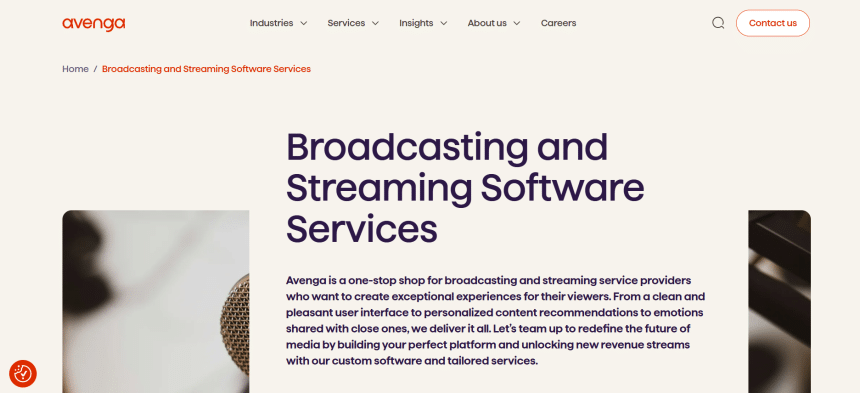
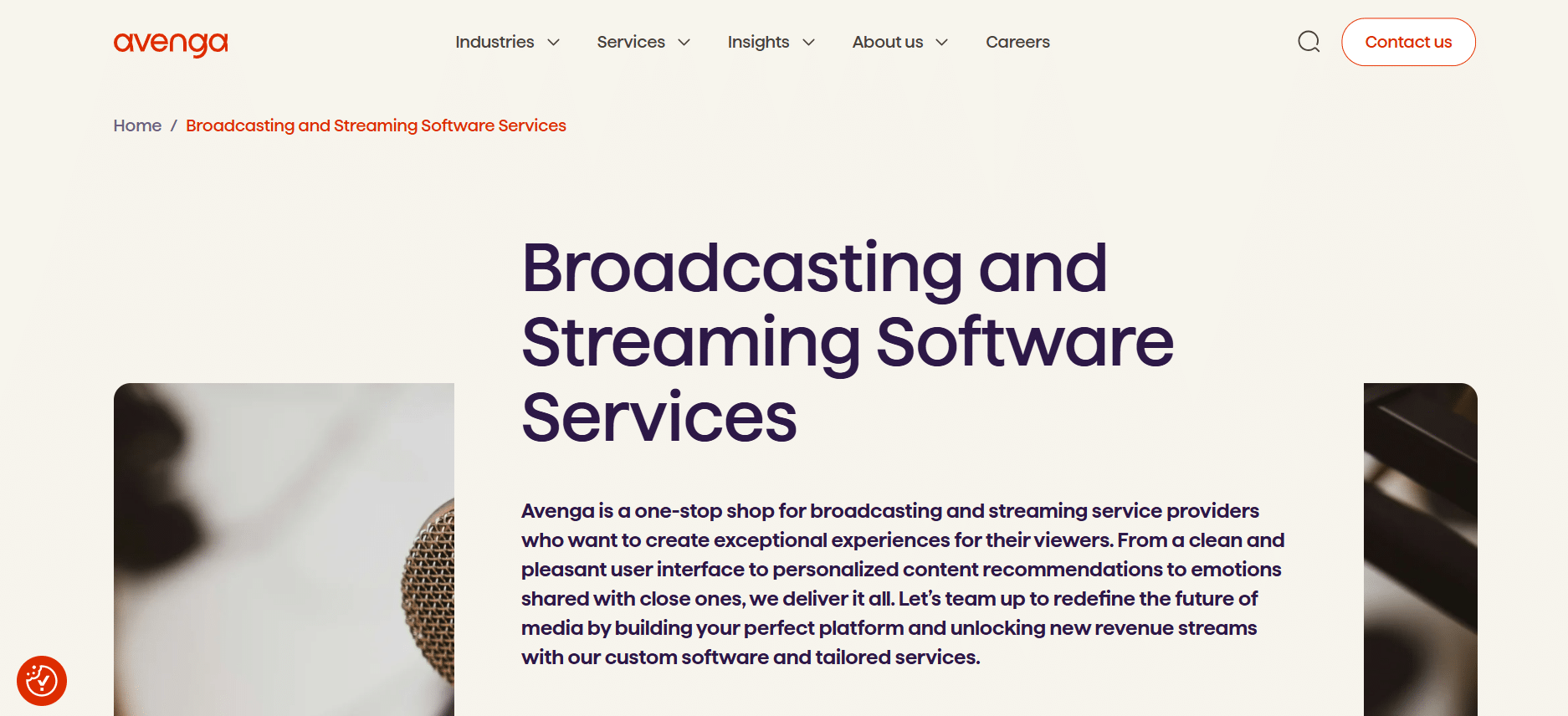
Avenga is a one-stop shop for broadcasting and streaming service providers that want to create exceptional viewer experiences. With two decades of experience working with startups and leading media houses worldwide, Avenga Media Streaming Software Development services reflect a deep understanding of digital media workflows.
The team creates solutions that assist companies in increasing viewer engagement, growing their audiences, and opening up new income sources by maintaining 99.9% uptime even in the face of tremendous demand.
Why They Stand Out:
What sets them apart is the scope. They handle the entire viewer journey, from first login to long-term retention. Backend systems in the cloud that connect content across platforms. Frontend work with clean design and AI-driven recommendations.
They also integrate AdTech and MarTech so streaming platforms can generate revenue. And they provide 24/7 security and operations management.
Key Services:
- Content Platform Development: Building feature-rich, scalable platforms to turn viewers into loyal customers.
- Live Streaming Solutions: Delivering high-quality, low-latency streaming across multiple devices.
- Data-Driven Solutions: Implementing advanced analytics and AI for personalized content and faster decisions.
- AdTech and MarTech Ecosystem Integration: Boosting ad revenue and improving audience targeting.
Leobit
Leobit operates at the intersection of media and technology, developing software for companies with ambitious projects.
Work spans the usual MediaTech categories—streaming, on-demand video, interactive platforms—with technical decisions guided by what’s current. Right now, that means a strong focus on AI and how it can be built into media products from the ground up.
Why They Stand Out
Leobit stands out because it focuses specifically on media solutions. While many vendors claim AI expertise, their work centers on media use cases such as content generation, recommendation systems, and real-time video analysis.
The platforms it develops support automatic content classification, issue detection, and scalable production workflows. Integration with Azure and AWS ensures the systems can handle real traffic and maintain stable performance.
Key Services:
- Live Streaming & Broadcasting Platforms: Focus on low-latency streaming and AI-powered recommendations.
- Interactive Media: Building immersive experiences with AR/VR integration and real-time interactivity.
- Video Workflow Automation: Speeding up production with AI-based transcription and automated editing.
- Video-on-Demand (VOD) Software: Creating feature-rich platforms with PPV and TVOD monetization.
Binary Studio
Binary Studio has been building streaming applications for about 19 years. They work across sports, music, education, and gaming—basically any industry that needs custom streaming software. Their approach focuses on transparency and treating client relationships as long-term partnerships rather than one-off projects.
Why They Stand Out
They focus on the front-end. The user interface, the interactive parts. So for a sports app, they’re handling the live game view with multiple camera angles and updating stats without lag. For music, it’s about making sure offline playback works and playlists are easy to manage. The engineering standards are high.
Key Services:
- Live Sports Streaming Platforms: Building apps with real-time updates, multiple camera angles, and in-game stats.
- Music Streaming App Development: Creating platforms with vast music libraries, customizable playlists, and social features.
- E-learning Streaming Platforms: Developing platforms for live and pre-recorded video lessons.
- Gaming Streaming Platforms: Creating Twitch-like apps focused on low-latency and interactive experiences.
Conclusion
Digital distribution requires media companies to maintain a technical infrastructure that supports reliable playback, content discovery, and revenue generation. The platform must address scalability, security, and interactive capabilities as baseline requirements.
Development partners offer different areas of expertise. Avenga handles full-stack platform builds and ongoing management. Leobit focuses on cloud architecture and AI-driven features. Binary Studio concentrates on user interface development and interactive elements. Media brands should assess their internal gaps and select a partner whose capabilities match those specific needs.