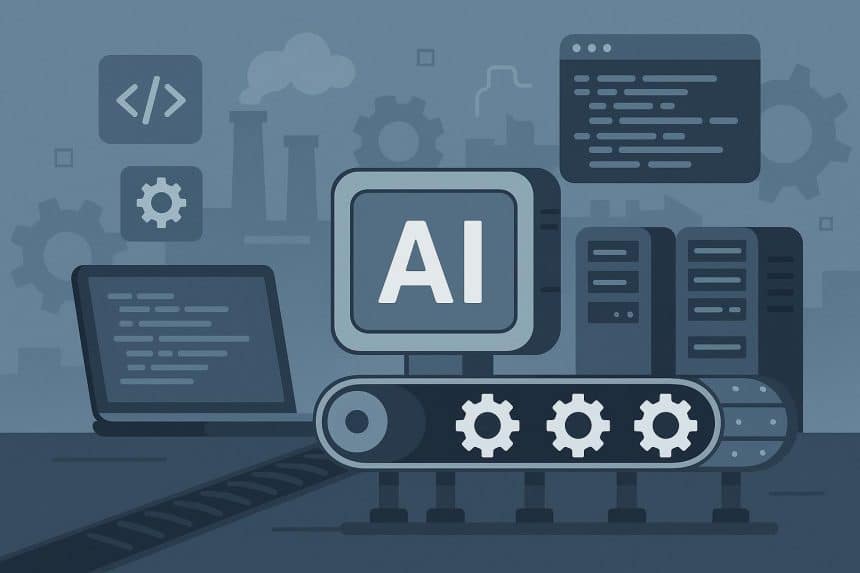
Many companies buy into the “AI magic” without understanding where the gears actually turn. It is not a button you press to get a finished product instantly. Instead, it is a sophisticated set of tools that helps teams move faster without burning out. In the real world, AI is a tool for efficiency, helping businesses turn ideas into working software before the competition even finishes their first meeting.
Predictive Maintenance and the End of Midnight Calls
Every developer has a horror story about the app crashing at 2:00 AM on a Saturday. Usually, these crashes happen because of a tiny problem that grew over time like a slow leak in a pipe. AI is now being used to watch the “logs” of an app and predict these leaks before the flood starts. It looks for patterns in how the server is behaving and warns the team that a crash is likely in the next few hours.
This proactive approach saves companies thousands of dollars in lost revenue and keeps the developers from losing their minds. Instead of fixing a disaster, the team just applies a quick patch during office hours. It turns the “firefighting” culture of software into a “prevention” culture. You aren’t just reacting to problems; you are staying three steps ahead of them.
- Real-time monitoring of user behavior to spot anomalies.
- Predicting server load spikes before they happen.
- Automatically flagging hardware that might fail.
- Analyzing error logs to find the root cause in seconds.
For a business, this means a more reliable product and a happier user base. People don’t care how cool your code is if the app won’t open when they need it. By using these predictive tools, you are building a reputation for stability. It is the kind of quiet success that doesn’t get a lot of headlines but makes a huge difference to the bottom line.
Bridging the Gap Between Design and Function
One of the biggest friction points in software is the “handover” from the designer to the developer. A designer creates a beautiful screen, and the developer has to spend hours or days trying to recreate that exact look with code. If you are involved in iOS app development, you know that getting every pixel and animation right for the iPhone screen is a painstaking process. AI is finally starting to bridge this gap by converting design files directly into working code.
This doesn’t mean the developer is useless, but it does mean they don’t have to spend their time writing the same CSS or SwiftUI code for the hundredth time. The AI generates the skeleton of the UI, and the developer focuses on the logic that makes the buttons actually do something. It turns a week-long task into a few hours of work. This speed allows companies to test new ideas much faster than they could five years ago.
- Instant conversion of sketches into basic HTML/Swift code.
- Suggesting UI improvements based on user accessibility rules.
- Automatically generating different versions of a screen for A/B testing.
- Syncing design changes across the whole app in one click.
This technology is making it possible for small startups to compete with giant corporations. You don’t need a team of fifty people to build a beautiful, high-quality app anymore. You just need a few talented people who know how to use the right tools. It is a democratization of the tech world that is opening doors for a lot of creative people who previously couldn’t afford the entry fee.
The New Skills for the Modern Engineer
The job of a software engineer is shifting from “how to write” to “how to ask.” We are seeing the rise of prompt engineering, where the skill is knowing exactly how to describe a problem so the AI can solve it. You also need a much stronger ability to verify and audit what the machine produces. You are becoming a project manager for a group of very efficient digital workers.
This requires a deeper understanding of architecture and system design. You need to know how all the pieces fit together, even if you didn’t type every piece yourself. If the AI builds a bad foundation, the whole house will eventually fall, no matter how pretty the paint is. A modern engineer needs to be a bit of a skeptic, always double-checking the machine’s work and looking for the hidden flaws.
- Mastering the art of descriptive prompting.
- Developing a “reviewer’s eye” for AI-generated logic.
- Focus on system security and high-level architecture.
- Learning to integrate multiple AI tools into one workflow.
Rarely has a profession changed so much in such a short time. It can be a little scary, but it is also incredibly rewarding for those who embrace it. You get to spend more of your time thinking and less of your time typing. You are moving from being a construction worker to being an architect. It is a more creative, strategic role that values your brain more than your fingers.
Conclusion
AI in software development isn’t about replacing the human heart of the project; it is about giving it a much stronger pair of lungs. We can now build bigger, faster, and more complex things without the traditional “growing pains” that used to kill great ideas. The future belongs to those who learn to lead the machines rather than run from them. If you’re looking to build something amazing but aren’t sure which tools to pick, the PixelPlex team is always ready to support your project. We have the deep technical roots and the forward-thinking vision to help you build software that truly stands the test of time.